


When Vishal Bhardwaj announces a gangster film, you know it’s not going to be your typical Bollywood masala. The director who gave us the dark brilliance of Maqbool and Kaminey is back with O’Romeo, and the buzz around this Shahid Kapoor starrer has one question dominating chai-time conversations: is this actually based on real people?
The smoke-filled bylanes of 1990s Mumbai. The razor-sharp tension of gang rivalries. The dangerous dance between loyalty and betrayal. O’Romeo drops you into the heart of Mumbai’s underworld, where love and revenge collide in a story too dark to be pure fiction. As Shahid Kapoor’s character navigates the treacherous world of hitmen and vendettas, audiences can’t help but wonder: did this really happen?
Quick Answer:
Yes and no. O’Romeo is a fictionalized drama inspired by real figures from Mumbai’s 1990s underworld. While the characters and their personal journeys are dramatized, the backdrop—gang wars, revenge plots, and brutal assassinations—is rooted in documented history. The film draws from a chapter in S. Hussain Zaidi’s Mafia Queens of Mumbai, with characters based on Hussain Ustara, Sapna Didi, and Dawood Ibrahim.
The Real Blood Behind the Reel Drama
Mumbai has always had two faces. One is the glittering city of Bollywood dreams and seaside promenades. The other? A shadowy underworld where power is measured in bodies and betrayals. The 1990s were when this dark side reached its peak—when gang wars spilled into the streets and names like Dawood Ibrahim became synonymous with terror.
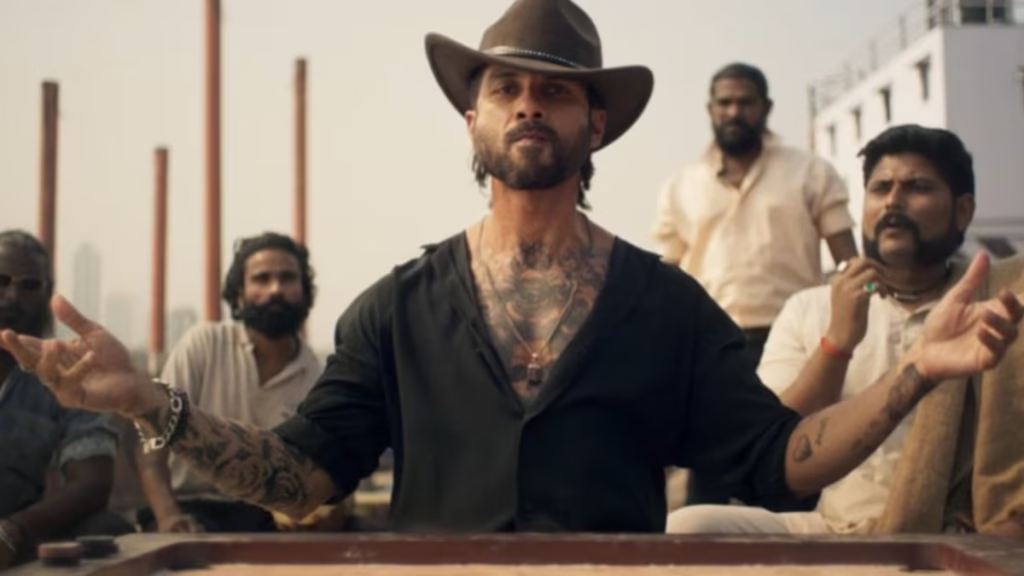
O’Romeo takes you back to that era, when the city’s underbelly operated with its own brutal code of honor. This wasn’t some distant, abstract criminal enterprise. It was happening in the same neighborhoods where families lived, where children went to school, where your chacha might have run a paan shop next to a gang safe house.
The film is adapted from investigative journalist S. Hussain Zaidi’s 2011 book Mafia Queens of Mumbai—the same source that gave us Gangubai Kathiawadi. But while Sanjay Leela Bhansali chose a story of survival and dignity in Kamathipura’s red-light district, Vishal Bhardwaj picked a chapter soaked in blood and revenge.
And the parallels to real events? They’re impossible to miss.
Check Out: O’Romeo Teaser: Shahid Kapoor Returns in Vishal Bhardwaj’s Intense Revenge Romance
The Story Behind Shahid Kapoor’s Character: Hussain Ustara
While Bhardwaj maintains that O’Romeo is a work of fiction, the character Shahid Kapoor plays is clearly inspired by Hussain Sheikh—a man who earned the fearsome nickname “Hussain Ustara” for his deadly precision with a razor.
Ustara wasn’t born into crime. But in 1980s-90s Mumbai, circumstances had a way of pulling people into the underworld’s gravitational field. He became one of the most feared hitmen in the city, operating in the dangerous space between rival gangs. His weapon of choice gave him his name, but it was his sharp instincts that kept him alive—at least for a while.
He was a formidable rival to Dawood Ibrahim during the height of gang wars that turned Mumbai’s streets into battlegrounds. In that world, loyalty was currency and betrayal meant death. Ustara navigated it all with the kind of ruthless intelligence that made him both respected and feared.
His story wasn’t about glory or heroism. It was about survival in a world where tomorrow was never guaranteed.
Sapna Didi: The Woman Who Chose Revenge Over Everything
If Hussain Ustara’s story is about survival, Sapna Didi’s is about what happens when grief transforms into something far more dangerous.
Her real name was Rahima Khan, but in Mumbai’s underworld, she became known as Sapna Didi. She wasn’t supposed to be part of this world. But when her husband, Mehmood Kaliya, was killed in a police encounter—an encounter she believed was orchestrated by Dawood Ibrahim—everything changed.
Grief has a way of burning through a person, and for Sapna Didi, it turned into an all-consuming need for revenge. In a male-dominated criminal ecosystem that rarely made space for women, she carved out her own path. Not as someone’s wife or sister, but as a force in her own right—driven, dangerous, and absolutely focused on making Dawood pay.
In the film, Triptii Dimri plays a character named Afsha, clearly inspired by Sapna Didi’s story. It’s perhaps one of the most challenging roles in recent Bollywood—a woman navigating the impossible terrain between love, loss, and vengeance.
The Sharjah Plot: When Revenge Met Reality
Here’s where the story gets its dramatic edge. According to Zaidi’s documented accounts, Sapna Didi and Hussain Ustara joined forces to execute an audacious plan: assassinate Dawood Ibrahim during a cricket match in Sharjah.
Think about the boldness of that. Not in some dark alley or through an ambush, but in public, during a cricket match, surrounded by thousands of people. It was theatrical, almost cinematic in its ambition. Cricket wasn’t just a game in the subcontinent—it was religion. And Dawood, who loved the sport and had deep connections in the cricket world, would be there, visible, vulnerable.
Or so they thought.
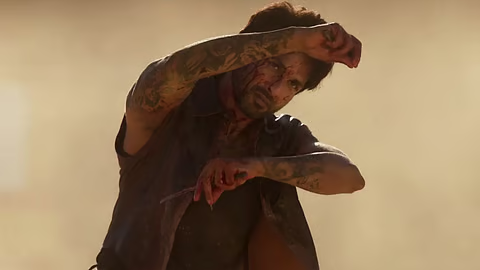
But Dawood hadn’t become the most powerful underworld don by being careless. He was always three steps ahead, playing chess while others played checkers. According to the accounts that form the basis of this story, he anticipated the plot. And in the world he controlled, anticipation meant elimination.
Sapna Didi was killed before she could execute her revenge. The hunter became the hunted. The woman who’d refused to accept her husband’s death as fate became another casualty in the endless cycle of underworld violence.
It’s the kind of tragic ending that feels almost Shakespearean—which might explain the “Romeo” in the film’s title.
What Makes It Feel So Hauntingly Real?
Vishal Bhardwaj has a gift for turning crime into something more than just violence and drama. His gangsters aren’t cartoons. They’re damaged people trapped in systems that chew them up and spit them out. Maqbool took Macbeth and made it bleed in the bylanes of Mumbai. Haider brought Hamlet to Kashmir’s conflict zones.
With O’Romeo, he’s working with material that’s already steeped in tragedy. The real Hussain Ustara and Sapna Didi weren’t heroes in the traditional sense. They were people who made choices—some forced upon them, others deliberate—that led them deeper into a world from which there was no clean exit.
The film captures the texture of 1990s Mumbai—the cramped neighborhoods where everyone knew everyone’s business, the code of silence that protected criminals, the police encounters that served as extrajudicial executions, the way gang affiliations could determine whether you lived or died.
It’s not just about action sequences and background scores. It’s about understanding what drives ordinary people to extraordinary violence. What makes someone pick up a weapon? What does love look like in a world defined by death? How does grief become a weapon in itself?
The Legal Storm Brewing
Just when you thought this was all historical water under the bridge, reality crashed back in. In January 2026, Sanober Sheikh—Hussain Ustara’s daughter—issued a legal notice to Vishal Bhardwaj, producer Sajid Nadiadwala, and the production team.
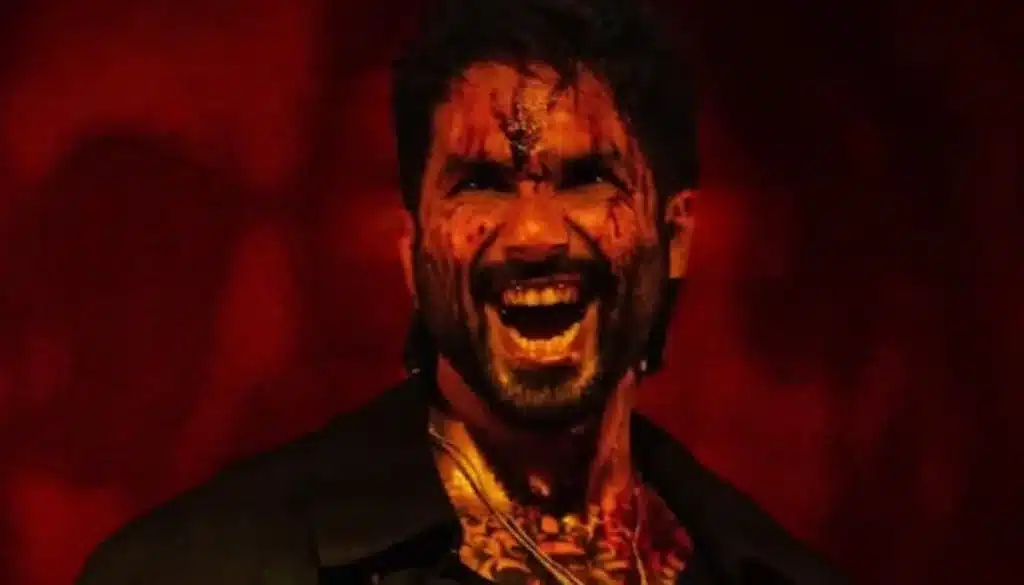
Her objections are clear and painful:
- The filmmakers never sought permission to portray her father’s life
- She alleges the film shows Hussain in an unfavorable or “bad” light
- She’s seeking up to ₹2 crore in damages
- She wants the February 13, 2026 release halted until her concerns are addressed
This raises questions that don’t have easy answers. When does a public figure’s documented criminal history become fair game for artistic interpretation? At what point does journalism about real events transform into something that requires family permission?
For Sanober Sheikh, this isn’t abstract. Whatever Hussain Ustara was to the world—hitman, gangster, criminal—to her, he was abba. Watching him portrayed on screen, even if based on documented facts, must feel like reopening wounds that never fully healed.
The filmmakers can argue they’re adapting published investigative journalism, not creating defamatory fiction. But the emotional truth of a daughter defending her father’s memory is something most of us can understand, regardless of the legal complexities.
So, Is It Based on a True Story?
Here’s the honest answer: O’Romeo isn’t a documentary. The characters are fictionalized. The romantic elements, the specific dialogues, the emotional arcs—these are dramatized for cinema.
But the backdrop? That’s as real as the streets of Dongri and the chawls of Byculla.
The 1990s gang wars happened. Hussain Ustara was real. Sapna Didi existed. Dawood Ibrahim’s shadow still looms over Mumbai decades later. The violence, the revenge plots, the brutal eliminations—all documented in police files and journalistic accounts.
The film doesn’t need to recreate events minute by minute. It’s inspired by the essence of that era—the fear, the power, the twisted honor codes, and the human cost of a world that operated outside the law.
O’Romeo isn’t about one true story. It’s about the truth behind many stories—the way love and violence intertwined in Mumbai’s underworld, the way grief could become a death sentence, the way choosing revenge meant accepting your own destruction.
Why This Story Still Resonates
You might wonder why a film about 1990s gangsters matters in 2026. Because the questions it raises haven’t disappeared. What happens when justice feels impossible through legal channels? How far would you go for the person you love? When does the line between victim and perpetrator blur beyond recognition?
For those of us watching from Mumbai, or from Edison or Brampton, this isn’t just entertainment. Our parents and grandparents lived through this era. They remember the fear that came with bomb blasts, the gang wars that made certain neighborhoods dangerous after dark, the way Dawood’s name could silence a room.
O’Romeo reminds us that Bollywood’s glittering exterior has always coexisted with Mumbai’s darker realities. The city that dreams is also the city that bleeds.
