

Narak Chaturdashi, popularly known as Choti Diwali, is one of the most spiritually significant days in the Hindu calendar. Celebrated as the second day of the five-day Diwali festival, it marks the triumph of Lord Krishna over the demon king Narakasura — symbolizing the eternal victory of light, goodness, and devotion over darkness and evil.
This Indian festival falls on the 14th day (Chaturdashi) of the waning fortnight (Krishna Paksha) in the Hindu month of Kartik. It is observed with pre-dawn sacred rituals, the lighting of diyas, feasting with family, and the joyful sound of firecrackers filling the evening air.
At its core, Narak Chaturdashi is a day of inner renewal. The ancient ritual of Abhyang Snan — a pre-sunrise oil bath performed in the presence of the moon — is the festival’s most sacred observance, believed to cleanse the devotee of sin, misfortune, and negativity. It is a day to shed laziness and darkness and step into the light of a new beginning.
The festival is primarily observed by Hindus across India, Nepal, and South Asian communities worldwide. In South India — particularly Tamil Nadu — Narak Chaturdashi is the main Diwali celebration itself. Across the Indian diaspora in the USA, UK, Canada, UAE, Singapore, and Australia, the festival is warmly observed as Choti Diwali, the eve of the main Diwali night.
When Is Narak Chaturdashi Celebrated in 2026?
Narak Chaturdashi falls on the Chaturdashi Tithi (14th lunar day) of Krishna Paksha in the Hindu month of Kartik, typically in October or November.
Narak Chaturdashi 2026 Dates in India
- Narak Chaturdashi / Choti Diwali: Sunday, November 8, 2026
- Abhyang Snan Muhurat: 05:36 AM – 06:38 AM IST (Duration: 1 hour 2 minutes)
- Chaturdashi Tithi Begins: 10:47 AM, November 7, 2026
- Chaturdashi Tithi Ends: 11:27 AM, November 8, 2026
Diwali 2026 — Five-Day Festival Calendar
| Day | Festival | Date |
|---|---|---|
| Day 1 | Dhanteras | Saturday, November 7, 2026 |
| Day 2 | Narak Chaturdashi / Choti Diwali | Sunday, November 8, 2026 |
| Day 3 | Lakshmi Puja (Main Diwali) | Monday, November 9, 2026 |
| Day 4 | Govardhan Puja | Tuesday, November 10, 2026 |
| Day 5 | Bhai Dooj | Wednesday, November 11, 2026 |
Table of Contents
Narak Chaturdashi In USA, Canada, Australia, New Zealand, UK, UAE, Singapore 2026 Dates
Narak Chaturdashi on Saturday, November 7, 2026
- Abhyang Snan Muhurat – 04:55 AM to 06:33 AM
- Moonrise at Abhyang Snan – 04:55 AM
Narak Chaturdashi on Saturday, November 7, 2026
- Abhyang Snan Muhurat – 05:23 AM to 07:01 AM
- Moonrise at Abhyang Snan – 05:23 AM
Narak Chaturdashi on Sunday, November 8, 2026
- Abhyang Snan Muhurat – 04:49 AM to 05:55 AM
- Moonrise at Abhyang Snan – 04:49 AM
Narak Chaturdashi on Saturday, November 7, 2026
- Abhyang Snan Muhurat – 05:17 AM to 07:04 AM
- Moonrise at Abhyang Snan – 05:06 AM
Narak Chaturdashi on Sunday, November 8, 2026
- Abhyang Snan Muhurat – 05:33 AM to 06:31 AM
- Moonrise at Abhyang Snan – 05:33 AM
Narak Chaturdashi on Sunday, November 8, 2026
- Abhyang Snan Muhurat – 05:41 AM to 06:46 AM
- Moonrise at Abhyang Snan – 05:41 AM
Why Do Narak Chaturdashi Dates Change Every Year?
Narak Chaturdashi is observed according to the Hindu lunisolar calendar, not the Gregorian calendar. It is fixed to the Chaturdashi Tithi (14th lunar day) of the waning fortnight in the month of Kartik.
Since a lunar year is approximately 11 days shorter than a solar year, the festival shifts each year on the Gregorian calendar and is corrected periodically by a leap month (Adhik Maas). In 2025, Narak Chaturdashi fell on October 19; in 2026, it arrives on November 8.
How Is Abhyang Snan Muhurat Decided?
The Abhyang Snan on Narak Chaturdashi must be performed during a precise window: after moonrise but before sunrise, while the Chaturdashi Tithi is still prevailing.
According to Hindu religious texts, this bath — ideally using sesame (til) oil for Abhyanga followed by Ubtan (herbal paste) — is believed to liberate the devotee from the cycle of suffering (Naraka).
It is always one day before or on the same day as Lakshmi Puja, depending on when Chaturdashi and Amavasya Tithis overlap. In 2026, the muhurat window is 05:36 AM to 06:38 AM IST on November 8. sunrise/sunset while maintaining the four-day lunar calendar sequence.
Narak Chaturdashi Other Names & Regional Identities

These are widely used names for the festival:
Narak Chaturdashi / Naraka Chaturdashi — Standard name across Hindi, Sanskrit, and most Indian languages. Choti Diwali — Colloquial Hindi name meaning the “younger” or “smaller” Diwali. Kali Chaudas — Used in Gujarat and Rajasthan, referring to the dark (Kali) 14th (Chaudas) and the worship of Mahakali. Roop Chaudas / Roop Chaturdashi — “Roop” means beauty; reflects the Abhyang Snan and beautification traditions of the day.
North & West India
Kali Chaudas — Gujarat, Rajasthan (day of Mahakali worship and Shakti veneration). Narak Nivaran Chaturdashi — Ritual name emphasizing liberation from Naraka.
East India
Bhoot Chaturdashi — West Bengal and Bangladesh; the night before Kali Puja when 14 ancestral spirits are believed to visit the family.
South India
Naraka Chathurdasi — Tamil Nadu, where this day is Diwali itself, not a precursor. Deepavali Bhogi — Used in some parts of South India to name the preceding festival day.
Diaspora / International Naming
Choti Diwali — The most widely used name across the Indian diaspora in the USA, UK, Canada, UAE, and Australia.
The Origins, History, and Legends of Narak Chaturdashi
Narak Chaturdashi is one of Hinduism’s ancient festivals, with its roots described in the Bhagavata Purana, Vishnu Purana, and Harivamsa. The festival carries both mythological and agricultural dimensions that have intertwined over centuries.
The central legend is the defeat of the demon king Narakasura by Lord Krishna. Narakasura (from nara, “man,” and aka, “sorrow” — the one who brings sorrow to men) had accumulated terrifying power and terrorised both mortals and the heavens. He abducted 16,100 women and stole the divine earrings of Aditi, mother of the gods. Hearing the prayers of the suffering people, Lord Krishna — accompanied by his wife Satyabhama, who embodies the warrior aspect of Bhumidevi (Earth Mother) — fought and beheaded the demon at dawn. Before dying, Narakasura requested that his death be celebrated with light and joy rather than mourning. It is in honour of this final wish that homes are illuminated with diyas and the sky is filled with firecrackers each Narak Chaturdashi.
In Maharashtra, Gujarat, and Rajasthan, the tradition holds that it was Goddess Kali who slew the demon — hence the name Kali Chaudas — and the day is dedicated to the worship of Mahakali and Shakti.
After slaying the demon, Lord Krishna took an oil bath during the Brahma Muhurta (pre-dawn auspicious hours) to purify himself. This act is the scriptural basis for the Abhyang Snan ritual that millions of devotees replicate every year.
Scholars also note that the use of fresh harvest poha (beaten rice) and the autumn timing of the festival point strongly to its origins as an agrarian harvest celebration, later woven together with the mythological narrative of Narakasura’s defeat.
Narak Chaturdashi: Cultural and Spiritual Significance
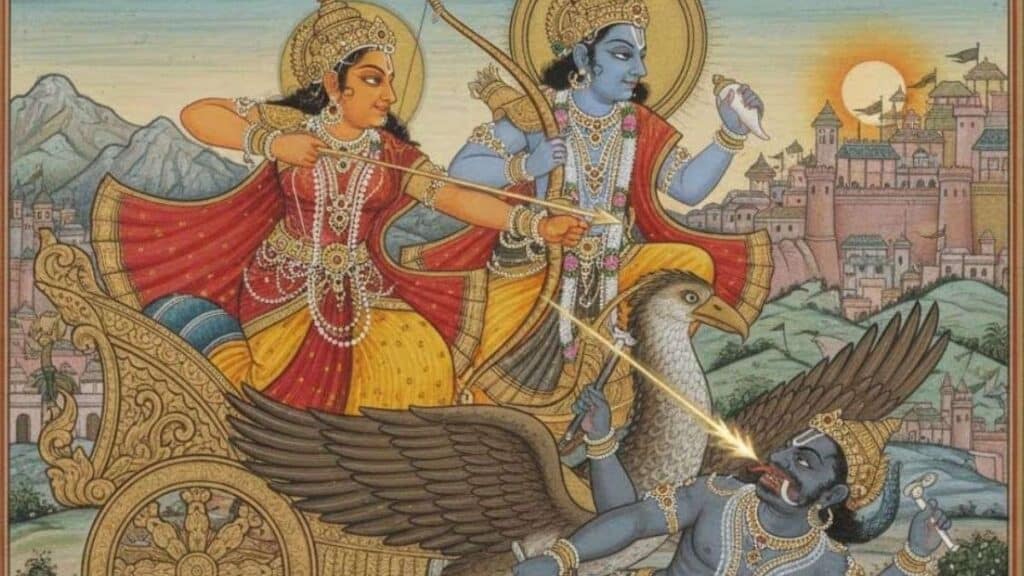
Narak Chaturdashi is a festival of inner transformation as much as outer celebration. The demon Narakasura symbolizes the darkness within every person — laziness, ego, ignorance, and the moral failures that create suffering. His defeat is a call to examine and defeat these qualities in oneself.
Spiritually, the Abhyang Snan is not merely physical cleansing but a symbolic shedding of accumulated negativity. The god of death, Yama, is venerated on this day by lighting a lamp facing south, believed to protect devotees from the suffering of Naraka in the afterlife. In some traditions, Kali Chaudas is the most auspicious night for worship of Mahakali and tantric practice, with heightened spiritual energy that accelerates the learning of mantras and deep devotional work.
Culturally, the festival brings families together through shared ritual, feasting, and the collective illumination of every home and street. The row of diyas stretching across darkened thresholds is among the most beautiful visual traditions in the world.
Narak Chaturdashi Prayers and Religious Observances
Prayers and rituals on Narak Chaturdashi are performed to seek purification, protection, and blessings for prosperity and family wellbeing.
The day begins before sunrise with Abhyang Snan — the sacred oil bath performed after massaging the body with sesame oil (Abhyanga) and applying Ubtan (a herbal paste of gram flour, turmeric, and sandalwood). This must be done during the moonrise-to-sunrise window while Chaturdashi Tithi prevails.
The puja is performed with oil, flowers, sandalwood, and kajal (kohl), which is applied to the eyes to ward off the evil eye (kali nazar). Coconuts are offered to Lord Hanuman with prasad of sesame seeds, jaggery, rice flakes (poha), ghee, and sugar. A lamp is lit facing south to honour and seek protection from Yama, the god of death.
Many families visit their Kula Devi (clan goddess temple) on this day, offering prayers for the removal of evil and ancestral blessings. Food is also offered to ancestors in certain regional traditions. The evening is celebrated with diyas, fireworks, and feasting with family and friends.
How Narak Chaturdashi Is Celebrated Across India

While the spirit of Narak Chaturdashi is universal, its expression varies richly across India’s regions.
In Maharashtra and Karnataka, the festival marks the formal start of Diwali. Women perform aarti for male family members and gifts are exchanged after the morning Abhyang Snan. Celebrations extend through Bali Padyami in Karnataka, considered the main Diwali day, when cows are decorated and worshipped.
In Goa, the festival is uniquely theatrical. Giant paper effigies of Narakasura — built on bamboo frames, painted with fierce expressions, and stuffed with firecrackers — are burned at 4 AM in spectacular pre-dawn displays. Families return home for the scented oil bath. A bitter berry called Kareet is crushed underfoot to symbolize the destruction of evil.
In Tamil Nadu, Naraka Chaturdashi is Diwali itself — the main day of celebration, not a precursor. Oil baths, aarti, pooja, Lakshmi Puja, and fireworks all happen on this day, while the rest of India holds the main celebration the following Amavasya night.
In Gujarat and Rajasthan, the festival is observed as Kali Chaudas with special worship of Mahakali and Shakti. It also retains strong harvest festival characteristics, with delicacies made from freshly harvested poha central to the day’s celebrations.
In West Bengal and Bangladesh, the day is observed as Bhoot Chaturdashi. Fourteen earthen diyas are lit in every corner of the home — in dark passages, stairwells, and doorways — to guide the spirits of 14 ancestors believed to return on this night, and to ward away malevolent ones..
Participation Across Religions in India
While Narak Chaturdashi is rooted in Hindu tradition, the broader Diwali season of which it is a part has become a widely shared celebration across communities. Neighbours of all faiths join in the joy of diyas, fireworks, and festive sweets.
In Gujarat, Hindu Kali Chaudas and Jain Diwali observances — marking Mahavira’s nirvana — occur within the same festive atmosphere, creating natural community convergence. Across Indian cities and towns, the illumination of streets and neighbourhoods draws participation that transcends religious identity.
The universal message at the heart of Narak Chaturdashi — that light overcomes darkness, that goodness defeats cruelty — resonates across every faith and community, making it a festival of shared human values as much as a religious observance.
How Narak Chaturdashi Is Celebrated Outside India

The Indian diaspora of over 32 million people worldwide carries Narak Chaturdashi traditions to every continent. In 2026, the festival falls on a Sunday, making it an especially vibrant year for diaspora celebrations.
In the United States, community organizations in New Jersey, Chicago, Houston, and the Bay Area host Diwali Mela events. Families perform the Abhyang Snan in the early morning and attend temple pujas, followed by community dinners and cultural programs in the evening.
In the United Kingdom, the famous Leicester Diwali illuminations and London’s Trafalgar Square Diwali event create a grand backdrop. Families observe morning rituals at home and attend mandirs and community halls for evening celebrations.
In Canada, cities like Brampton and Mississauga host vibrant Diwali community events. The Abhyang Snan is performed at home, followed by temple visits and neighbourhood gatherings.
In the UAE, the large South Asian community gathers at Hindu temples in Dubai and Abu Dhabi for morning prayers and evening festivities including mithai exchange and cultural programs.
In Singapore, Little India’s Diwali light displays run through November. Australian cities like Melbourne and Sydney host temple events and cultural shows across the Diwali weekend.
Narak Chaturdashi Gifting Traditions
Narak Chaturdashi and Choti Diwali are a cherished time for gift exchange, symbolizing love, renewed relationships, and the sharing of joy.
Traditional gifts include diya sets and oil lamp collections, mithai boxes with kaju katli and ladoo, and herbal Ubtan and sesame oil kits — especially meaningful on Roop Chaudas, the “day of beauty.” Premium dry fruit hampers, silver Lakshmi-Ganesha coins, and eco-friendly Diwali kits with seed diyas and organic incense have become popular across urban India and the diaspora.
Corporate gifting during the Diwali season often centres on curated hampers combining traditional sweets with wellness and lifestyle items.
Narak Chaturdashi Foods and Culinary Traditions

Food is central to the day’s celebrations, with a lavish midday meal shared with family and friends after the morning rituals.
Common Narak Chaturdashi delicacies include:
- Poha (beaten rice preparations) — the traditional harvest dish, made from freshly harvested rice, prepared sweet or savoury
- Tilgul Ladoo — sesame and jaggery balls, ritually significant as sesame is used in the oil bath and offered to Hanuman
- Chakli — crisp spiralled rice flour snacks, a Maharashtra Diwali classic
- Karanji (Gujiya) — deep-fried pastry filled with coconut, khoya, or dry fruits
- Shrikhand — thick saffron-sweetened yogurt, a Gujarat and Maharashtra festive favourite
- Besan Ladoo — gram flour sweets shared as prasad and neighbourly gifts
- Chivda — spiced flattened rice mix, the savoury balance to the season’s many sweets
These dishes are prepared in advance and shared generously with neighbours, friends, and guests.
Narak Chaturdashi : Music, Art, and Cultural Expression
Sound and art are inseparable from Narak Chaturdashi. The pre-dawn air in Goa carries dhol-tasha percussion accompanying Narakasura processions. Devotional bhajans dedicated to Lord Krishna and Goddess Kali fill temples and homes. In West Bengal, the beating of dhak drums marks the preparations for Kali Puja beginning on Bhoot Chaturdashi.
Elaborate rangoli — drawn on thresholds and courtyards with coloured powders, flower petals, or rice flour — transforms homes into living art. Goa’s Narakasura effigy-building has evolved into a community craft tradition, with some figures reaching 30 feet tall and incorporating social commentary through their design.
Classical dance performances — Bharatanatyam, Kuchipudi, and Odissi — depicting Krishna’s victory over Narakasura are staged in cultural auditoriums across South India during the Diwali season.ies. Cinema (Gangs of Wasseypur) and television feature Chhath prominently, while #ChhathPuja trends globally on social media.
Narak Chaturdashi’s Modern Relevance and Cultural Continuity
Narak Chaturdashi continues to evolve while staying rooted in its essential spirit. Growing environmental awareness has driven a meaningful shift toward clay diyas, organic rangoli colours, and reduced firecrackers in urban households and diaspora communities. Many cities now hold “green Diwali” campaigns with community diya lighting as the centrepiece.
The Abhyang Snan has found new resonance in India’s wellness movement, reframed as an Ayurvedic self-care ritual. Herbal sesame oil massages and Ubtan kits are marketed as both traditional and contemporary practices, attracting younger urban Indians who connect with the ritual’s wellness dimension even outside its devotional context.
On social media, Narak Chaturdashi generates millions of posts — Narakasura effigy burns live-streamed from Goa, Abhyang Snan morning routines, rangoli time-lapses, and festive recipe videos. Diaspora families connect across time zones through video calls during the morning puja and evening diya lighting.
How to Wish Someone on Narak Chaturdashi:
- “Happy Narak Chaturdashi! May light and joy fill your home this Choti Diwali.”
- “Shubh Kali Chaudas — may Goddess Kali’s blessings protect you and your family.”
- “Happy Roop Chaudas! Wishing you beauty, health, and happiness. 🪔”
- “Narak Chaturdashi ki shubhkaamnayein — may all darkness give way to the glow of your diyas.”
Cultural Reflection
Narak Chaturdashi endures because its message is both ancient and immediate. Each year, in the hours before dawn, families across India and the world wake to anoint themselves with sesame oil and light the first diyas of the Diwali season — replicating an act that scripture says Lord Krishna himself performed after his greatest victory.
The demon in the story is not only a mythological figure. He is the darkness each of us carries: the laziness that dims our potential, the ego that creates suffering, the ignorance that keeps us from seeing clearly. When we crush the Kareet berry underfoot or burn the Narakasura effigy in the pre-dawn dark, we are making a conscious choice to step out of our own naraka and into the light.
In a world that increasingly needs reminders of our shared humanity, Narak Chaturdashi offers exactly that — the universal truth that goodness will prevail, that darkness is temporary, and that the simplest diya, placed in the darkest corner, changes everything.
🪔 Shubh Narak Chaturdashi 2026 · Happy Choti Diwali · Kali Chaudas ki Shubhkaamnayein