


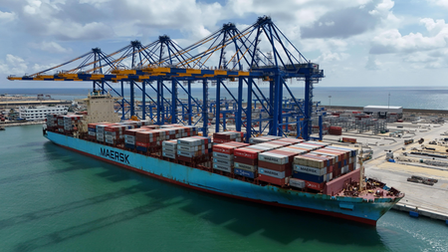
A significant milestone has been reached at the Port of Colombo in Sri Lanka, where the Colombo West International Terminal (CWIT) operated by Adani Ports and Special Economic Zone Ltd (APSEZ) has surpassed one million TEUs in its inaugural year. This rapid ramp-up underscores the strategic importance of the Indian Ocean region in global trade and the growing role of the blue economy. The CWIT’s achievement of reaching this scale within its first year positions it among a select group of global facilities.
The CWIT, a joint venture involving APSEZ, John Keells Holdings PLC, and the Sri Lanka Ports Authority, represents a substantial investment of approximately $800 million in Sri Lanka’s port infrastructure. Colombo’s strengthening position as a key transshipment hub connecting cargo flows across Asia, the Middle East, and Europe has contributed to the terminal’s early success. The port’s strategic location along major shipping routes has historically made it a preferred stop for mainline vessels and feeder networks.
Unlike many container terminals that take years to stabilize operations, the CWIT has demonstrated strong early performance due to effective alignment with shipping lines, high berth productivity, and integration within an established transshipment ecosystem. This achievement is particularly noteworthy given that even newer automated terminals in other regions have taken longer to achieve comparable utilization levels.
The Colombo West International Terminal, equipped to handle the latest ultra-large container vessels, is the first fully automated deep-water terminal at the Port of Colombo. With a 1,400-meter quay and a water depth of around 20 meters, it can accommodate some of the largest ships on the Asia-Europe trade route. The terminal’s annual capacity of approximately 3.2 million TEUs significantly enhances Colombo’s handling capabilities, with advanced systems aimed at reducing turnaround times and enhancing operational efficiency.
The early success of the CWIT not only highlights Colombo’s significance in global shipping networks but also underscores the critical role of efficiency and connectivity in sustaining growth, especially in handling transshipment cargo linked to India. For APSEZ, which manages a diverse portfolio of ports, this project represents a key milestone in expanding its international presence and solidifying its position as India’s largest private port network. The collaboration with John Keells Holdings PLC and the Sri Lanka Ports Authority brings together global operational expertise and local institutional support.
