


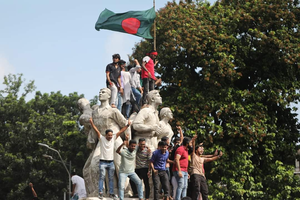
In Bangladesh, there are ongoing attempts to diminish the legacy of Sheikh Mujibur Rahman, the country’s founding father. Recently, Dhaka University renamed the Sheikh Mujibur Rahman Hall to ‘Osman Hadi Hall’ in honor of a slain radical Islamist leader. This move is part of a broader trend of erasing Mujibur Rahman’s presence, with reports of vandalism on statues, murals, and even his family home.
Protests have erupted, with visuals showing individuals defacing statues of Mujibur Rahman in celebration of former Prime Minister Sheikh Hasina’s resignation. Changes have also been made in textbooks and currency, removing references to Mujibur Rahman as the “Father of the Nation.” These actions are seen as an attempt to rewrite history and redefine Bangladesh’s national identity post-Hasina era.
The renaming of university halls after radical figures and the rise of hardline groups like Islami Chhatra Shibir indicate a shift towards a more conservative ideology. This shift has raised concerns about communal violence and political polarization in the country. The changes also pose a challenge for the opposition party led by Tarique Rahman, as they face defeats in student union elections against groups like Islami Chhatra Shibir.
As Bangladesh prepares for national elections, the country is at a crossroads between honoring historical figures and embracing new ideologies. The removal of Mujibur Rahman’s symbols reflects a broader struggle for power and influence in the country. These developments not only impact Bangladesh’s internal dynamics but also raise concerns for neighboring countries like India, which have historical ties to Mujibur Rahman and his legacy.
