


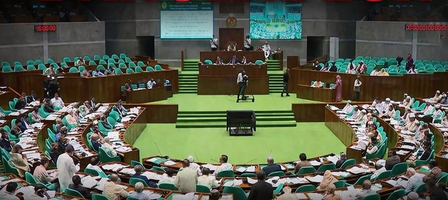
Bangladesh’s Awami League has strongly criticized a parliamentary bill that effectively prohibits the party, labeling it a “disgraceful act” and a direct assault on democratic principles. The bill, known as the Anti-Terrorism (Amendment) Bill 2026, was passed by the parliament without changes to the Anti-Terrorism (Amendment) Ordinance 2025 issued by the Muhammad Yunus-led interim government. This ordinance amended the anti-terrorism law to halt all activities of the Awami League until the completion of the party and its leaders’ trial at the International Crimes Tribunal.
The Awami League condemned the bill, stating that the National Parliament of Bangladesh has been disgraced and history has witnessed a shameful episode. The party highlighted that a parliament formed through a so-called election has passed a bill banning the historic political party that played a crucial role in Bangladesh’s Liberation War. The Awami League emphasized that such actions not only target a single party but also undermine democratic practices, a fair political system, and the people’s fundamental rights.
Expressing concerns, the party mentioned that efforts to ban a political institution with a rich history and struggle go against the essence of democracy, potentially leading the country towards a one-party or authoritarian direction. The Awami League stressed that the move signifies hostility towards history itself, something that the people of Bangladesh will not tolerate. The party emphasized that repression, bans, or the misuse of laws do not offer lasting solutions but instead create instability, division, and hinder democratic values.
The Awami League called for unity among pro-democracy citizens, political parties, civil society, professional organizations, and the youth of Bangladesh in the fight for democratic rights, freedom of expression, and the rule of law. It asserted that the victory of the people and democracy is certain, and they will persist in their movement and struggle, drawing inspiration from history and staying firm in their beliefs.
