


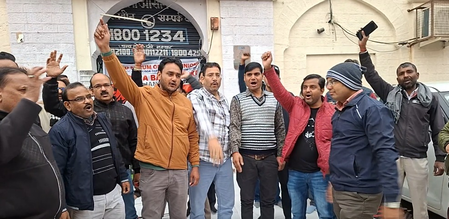
Bank employees across the country went on strike to demand the immediate implementation of a five-day work week, causing disruptions in banking services like cash transactions and cheque clearances. The strike, organized by the United Forum of Bank Unions (UFBU), saw large participation in various states. Employees expressed frustration over the delay in adopting a five-day work week, a practice already followed by other institutions.
In Gujarat’s Vadodara, nationalized bank employees joined the strike, emphasizing that their demand for a shorter work week had been pending since 2015. The absence of concrete action from the government led to the widespread closure of bank branches, inconveniencing customers. Across India, more than eight lakh bank employees participated in the strike, highlighting the prolonged wait for the implementation of a five-day banking schedule.
In West Bengal’s Cooch Behar, bank employees protested in front of various banks, stressing that most offices in India and banks worldwide operate on a five-day basis. Despite assurances from the Indian Banks’ Association (IBA), the transition to a five-day work week in nationalized and private banks has not materialized. The demand for a shorter work week has been a longstanding issue, with employees expressing disappointment over repeated delays in its implementation.
In Uttar Pradesh’s Ghazipur district, over 10,000 bank employees from nearly 250 banks participated in the strike, disrupting transactions worth over Rs 150 crore. The strike, aimed solely at achieving a five-day banking schedule, halted banking activities across the district, affecting customers and businesses. In Lucknow, the All India Bank Officers’ Confederation (AIBOC) reiterated the demand for a five-day work week, emphasizing the prolonged nature of this request.
In Chandigarh, the one-day strike impacted normal banking operations as employees gathered outside bank branches to advocate for a five-day work week. Similarly, in Chhattisgarh’s Raipur, around 25,000 bank employees from nearly 2,500 banks participated in the strike, severely affecting banking services across the state. The demand for a shorter work week has been a consistent plea from bank employees, underscoring the need for immediate action.
In Patna, Punjab National Bank employees highlighted the unfulfilled promise of implementing a five-day work week within six months, as agreed in the bipartite settlement. Despite the passage of two years, the demand remains unresolved, prompting employees to strike. In Rajasthan’s Dholpur, the strike led to the complete closure of banks, disrupting essential services and causing inconvenience to the public due to the absence of cash transactions and cheque clearances.
