


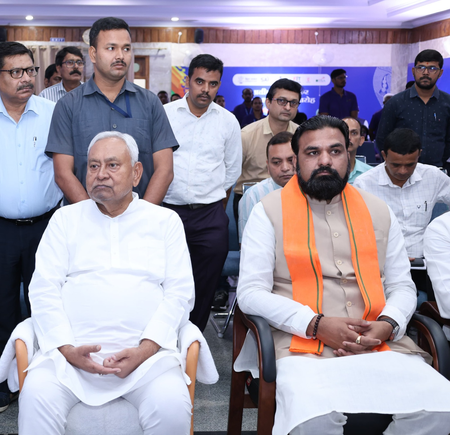
Bihar is experiencing significant political changes as Chief Minister Nitish Kumar resigns, concluding his long-standing leadership in the state. The Janata Dal (United) leader is set to convene a cabinet meeting before stepping down, paving the way for the Bharatiya Janata Party (BJP) to assume control, a crucial ally in the National Democratic Alliance (NDA).
After the cabinet meeting, Nitish Kumar, who recently entered the Rajya Sabha, will tender his resignation to Bihar’s Governor Syed Ata Hasnain. The BJP has not yet announced its choice for the next Chief Minister, but Deputy Chief Minister Samrat Choudhary is a prominent candidate, given his role overseeing the Home Ministry in the outgoing administration.
Speculation also surrounds Nishant Kumar, Nitish Kumar’s son, as a potential successor. While the JD(U) leans towards Nishant Kumar, the BJP is positioning itself as the rightful contender for the leadership role. Public opinion appears divided between Samrat Choudhary and Nishant Kumar, with a preference for a Chief Minister from the Other Backward Classes (OBC) category, which both candidates belong to.
As preparations for the leadership transition unfold, signs of change are evident, such as Nitish Kumar’s posters being removed from the JD(U) office in Patna. All 202 MLAs of the ruling alliance have been instructed to remain in the state capital, with Nitish Kumar already beginning to vacate his official residence on Circular Road.
To oversee the transition smoothly, the BJP has appointed Union Minister Shivraj Singh Chouhan as the central observer. Chouhan, along with Nitin Nabin, will participate in the meeting to finalize the selection of the new Chief Minister.
