


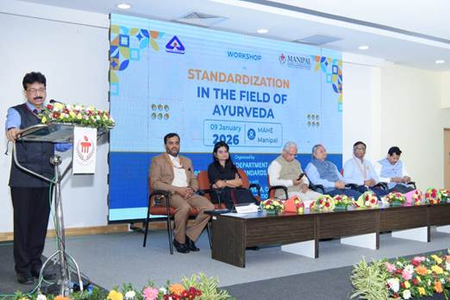
The Bureau of Indian Standards (BIS) has reiterated its dedication to improving quality and safety in Ayurveda through robust standardization efforts. In collaboration with the Manipal Academy of Higher Education (MAHE), the BIS conducted a national-level workshop focused on enhancing standards in the Ayurveda sector. Nearly 180 delegates, including faculty members, researchers, startups, and industry representatives, participated in the event, marking a significant milestone in the journey towards bolstering quality, safety, and global recognition of Ayurveda.
Shrishti Dixit, Head of the AYUSH Department at BIS, emphasized the organization’s commitment to enhancing quality and safety in Ayurveda through comprehensive standardization mechanisms. She highlighted the pivotal role of standards in building trust, crucial for the international acceptance and wider adoption of Ayurveda. The workshop, themed around BIS’s motto “Manakah Patha Pradarshaka,” underscored the importance of standards in aligning traditional Ayurvedic knowledge with modern scientific and regulatory frameworks.
Jayant Deopujari, Chairperson of the Ayurveda Sectional Committee at BIS, described the workshop as a significant stride towards bridging traditional Ayurvedic wisdom with contemporary needs through structured standardization. He stressed the collective responsibility of stakeholders in establishing Ayurveda as a globally trusted healthcare system. Dr. Sharath K Rao, Pro Vice-Chancellor – Health Sciences at MAHE, highlighted the urgent necessity for standardization in traditional systems like Ayurveda and assured full support from MAHE in advancing the government’s national initiative.
Discussions during the workshop centered on interdisciplinary collaboration, the role of standards in supporting Ayurveda startups, and the industry’s responsibility in ensuring quality and compliance. Participants actively exchanged ideas and insights on advancing standardization in Ayurveda, emphasizing the need for interdisciplinary research, academia-industry partnerships, and targeted capacity-building initiatives to foster a sustainable ecosystem involving academia, industry, and policymakers for Ayurveda standardization.
