


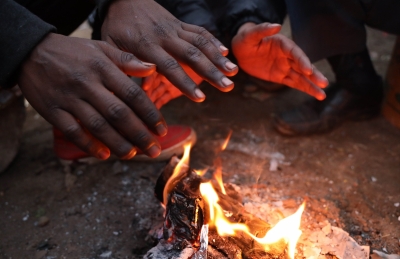
Burning firewood at home in winter can significantly contribute to air pollution and premature deaths, a study revealed. The study, published in Science Advances, highlighted that residential wood burning accounts for around 22% of PM2.5 pollution during winter, making it a major source of fine particle pollution in the coldest months. Researchers from Northwestern University found that pollution from residential wood burning leads to approximately 8,600 premature deaths annually in the US.
Using alternative heating appliances instead of burning wood is recommended to reduce fine particulate matter in the air and lower the risk of cardiovascular diseases. Daniel Horton, an Associate Professor of Earth at the university, emphasized the importance of transitioning to cleaner or non-burning heat sources in homes to improve air quality significantly. The study specifically focused on emissions from wood-burning furnaces, boilers, fireplaces, and stoves in residential settings.
The research team utilized a high-resolution atmospheric model to simulate the movement of pollution in the air, considering factors like weather, wind, temperature, terrain, and atmospheric chemistry to predict air quality changes over time. According to Horton, emissions from wood burning, including primary pollutants like black carbon, can form secondary species of particulate matter pollution, exacerbating air quality issues.
Particulate matter from wood burning poses a particular challenge in urban and suburban areas due to factors such as population density, emissions density, and atmospheric transport. Even cities not commonly associated with wood burning can experience air quality impacts during cold spells, recreational burning, and atmospheric dispersion from surrounding areas. The study underscores the need for transitioning to cleaner heating options to mitigate the adverse effects of residential wood burning on air quality.
