


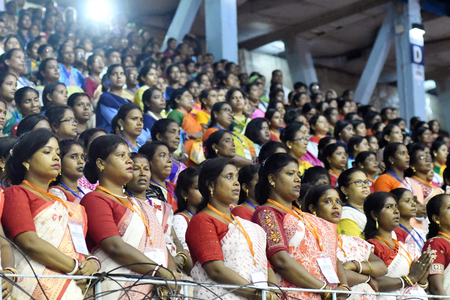
Cash transfer schemes implemented in Maharashtra and Odisha have led to increased savings and spending on healthcare and education for underprivileged women, benefiting their families as a whole. A recent report by the Economic Advisory Council to the Prime Minister revealed that these programs have not only bolstered the financial resilience of recipients but also boosted their consumption capabilities. The study focused on Maharashtra’s Mukhyamantri Majhi Ladki Bahin Yojana and Odisha’s Subhadra Yojana, analyzing monthly bank account data.
The research highlighted that beneficiaries of Maharashtra’s Ladki Bahin program saw an 84% increase in month-end balances, amounting to Rs 6,884 per beneficiary, while monthly expenditures surged by 46%, equivalent to Rs 1,349. With a monthly transfer amount of Rs 1,500, the estimated marginal propensity to consume was approximately 0.90 for Maharashtra, indicating that beneficiaries spent almost 90 paise of every additional rupee received while still managing to save, underscoring the financial constraints faced by low-income households.
Both initiatives demonstrated positive spillover effects within households, enhancing the financial well-being of family members and reducing overall expenditure. The report emphasized that globally, women-centric cash transfers have shown to yield more significant developmental outcomes compared to gender-neutral transfers, with India witnessing a digital transformation in payment mechanisms. It recommended the continuation and enhancement of these programs by integrating income transfers with capacity-building, digital literacy, and Self-Help Group (SHG) linkages.
Beneficiary targeting for these schemes should be progressively improved through advanced multidimensional verification frameworks to ensure precise inclusion without excluding any eligible women. The study advocated for the evolution of these programs towards cash-plus models to further empower women economically.
