


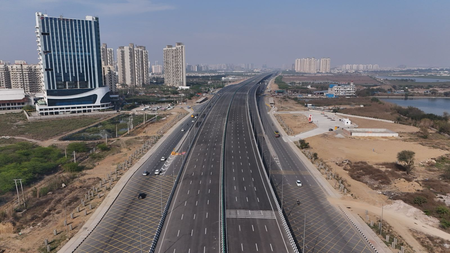
The Centre’s approval of the Rs 6,969.67 crore Dwarka Road Tunnel project is expected to revolutionize urban mobility in the National Capital Region (NCR). This project aims to alleviate traffic congestion, enhance airport connectivity, and establish a seamless link between West and South Delhi. The Ministry of Road Transport & Highways stated that the project will connect the Shiv Murti Interchange on the Dwarka Expressway with Nelson Mandela Marg in Vasant Kunj, offering a high-speed route for commuters from Gurugram, Dwarka, Indira Gandhi International Airport, and West Delhi.
The corridor’s key highlight is a 3.14-km twin-tube tunnel, with a 1.98-km section beneath the Southern Ridge, designed to enhance connectivity while preserving one of Delhi’s ecologically sensitive areas. By reducing reliance on congested routes like Dhaula Kuan-IGI Airport-Mahipalpur, Chhatarpur-Mahipalpur, and Rangpuri, the project is anticipated to provide faster and more reliable travel for commuters, airport passengers, and commercial vehicles. Additionally, it will strengthen connectivity between Delhi and Gurugram, improving access to residential areas, commercial hubs, institutional centers, and the airport.
The tunnel will complement NHAI’s proposed AIIMS-Mahipalpur Elevated Corridor, linking it to the Barapullah Elevated Road, thereby enhancing east-west connectivity across Delhi. This will facilitate better travel to East Delhi, Ghaziabad, and Noida. Furthermore, the project is set to enhance the experience for both domestic and international visitors by improving connectivity from the airport to major tourist attractions, including Qutub Minar, Mehrauli Archaeological Park, Hauz Khas Heritage Complex, and more.
Apart from easing congestion, the project focuses on environmental sustainability. The underground tunnel beneath the Southern Ridge is expected to minimize surface disruption while preserving Delhi’s greenery. The Dwarka Tunnel Corridor is viewed as a strategic investment in future-ready transport infrastructure that will not only enhance urban mobility but also support economic activities and strengthen connectivity across the National Capital Region. Recently, the Cabinet Committee on Economic Affairs (CCEA) approved the 8.1-km, six-lane access-controlled corridor, which will be developed by NHAI under the Ministry of Road Transport and Highways on the Hybrid Annuity Mode (HAM).
