


Delhi Chief Minister Rekha Gupta expressed gratitude to Prime Minister Narendra Modi for key decisions made by the Union Cabinet aimed at enhancing infrastructure and economic development in the National Capital. She emphasized the significance of these decisions for Delhi’s progress in various aspects, including infrastructure, economy, and cultural preservation. Chief Minister Gupta highlighted the approval for the construction of additional rail lines on the Delhi-Ambala route to improve the capital’s rail network and enhance passenger mobility.
The transformation of the historic North and South Blocks into the grand Yuge Yugeen Bharat National Museum was noted as a pivotal step in preserving Delhi’s cultural heritage and elevating its global recognition. Additionally, initiatives such as the Urban Challenge Fund and ‘Startup India Fund 2.0’ were acknowledged as crucial for modernizing urban planning in Delhi and creating new opportunities for the youth. Chief Minister Gupta extended her thanks to Prime Minister Modi for the continuous support towards Delhi’s development and the welfare announcements made by the Central Government.
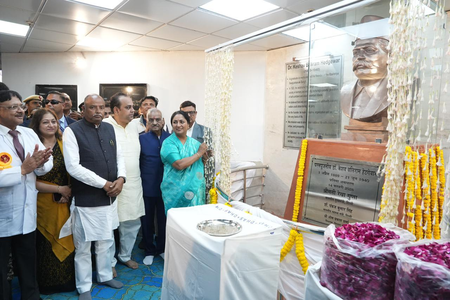
During an event in East Delhi, Chief Minister Gupta unveiled a statue of Dr. Keshav Baliram Hedgewar, the first Sarsanghchalak of the Rashtriya Swayamsevak Sangh (RSS), at the Dr. Hedgewar Arogya Sansthan in Shahdara. She praised Dr. Hedgewar’s mission, emphasizing its contribution to the nation through the establishment of a strong and extensive organization. The Chief Minister highlighted Dr. Hedgewar’s approach to societal organization through individual development as a cornerstone of India’s cultural revival, stating that the statue at the institute serves as a perpetual source of inspiration for service, dedication, and national pride.
In a social media post, Chief Minister Gupta celebrated the significance of the event, marking the centenary year of the Sangh’s establishment. She reflected on the enduring impact of Dr. Hedgewar’s vision, planted a century ago, which has flourished into a profound symbol of service to the nation. His philosophy of societal organization through individual character-building was hailed as a fundamental element of India’s cultural renaissance.
