


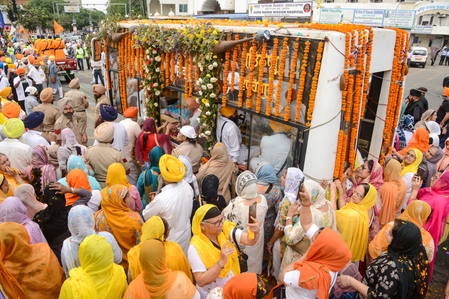
Hundreds of devotees gathered at gurudwaras in Punjab and Haryana to observe Baisakhi, a significant festival commemorating the establishment of the Khalsa Panth by Guru Gobind Singh. This festival also heralds the beginning of the harvest season. The Golden Temple in Amritsar was adorned beautifully, attracting a large number of early morning worshippers.
The Shiromani Gurdwara Parbandhak Committee (SGPC), responsible for managing gurudwaras in Punjab, Himachal Pradesh, and Chandigarh, has deployed additional staff to handle the festive crowds. At Takht Kesgarh Sahib in Anandpur Sahib, where the Khalsa Panth originated in 1699, a multitude of devotees were present.
Many individuals view taking a sacred dip in the Golden Temple sarovar as a significant ritual on this day. Extensive langars (community kitchens) have been set up for the occasion. Apart from the Golden Temple, numerous historic gurudwaras in Punjab witnessed devotees partaking in the festivities.
Punjab Chief Minister Bhagwant Mann conveyed his greetings for Baisakhi and Sajna Diwas of Khalsa Panth, emphasizing the values of righteousness and service to humanity instilled by the Khalsa Panth. This day also signifies the ripening of the Rabi harvest, a crucial period for wheat farmers. Additionally, the day holds historical importance in India’s freedom movement, particularly the Jallianwala Bagh massacre in 1919.
A group of pilgrims departed for Gurudwara Sri Panja Sahib in Pakistan from Amritsar to attend a religious gathering marking Khalsa Sajna Diwas (Baisakhi). Haryana Chief Minister Nayab Singh Saini extended his heartfelt wishes for a prosperous and joyous Baisakhi, emphasizing the festival’s message of well-being and prosperity for farmers.
