


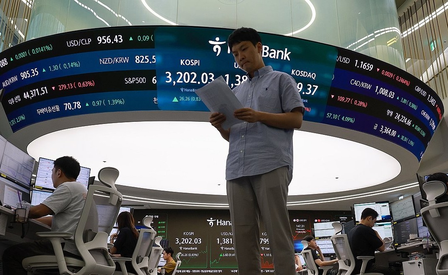
Foreign investors have transitioned from being net sellers to net buyers in South Korea’s stock market, particularly focusing on technology and automotive shares. Data from the Korea Exchange revealed that foreign investors injected a net 1.9 trillion won (US$1.3 billion) into the Korea Stock Price Index (KOSPI) market from December 1 to the present, marking a significant reversal from November when they sold a net 14.4 trillion won. Notably, offshore investors have shown interest in prominent semiconductor manufacturers and auto firms.
The trend continued with foreign investors purchasing 373.2 billion won worth of local stocks by 11:10 a.m. on Tuesday. Among their key investments were in SK hynix, where they acquired a net 824.7 billion won, as well as preferred shares at Samsung Electronics and shares of Hyundai Motor. Analysts attribute this shift to favorable conditions in the U.S. stock market, particularly advancements in AI-related stocks, driving the year-end stock rally.
The recent surge in U.S. chipmaker Micron Technology’s stock, reaching a record high of $230.55, further fueled optimism due to strong demand for its AI infrastructure memory chips. Additionally, the trade agreement between Seoul and Washington in October has alleviated tariff uncertainties for local carmakers, contributing to the positive sentiment in the sector. Analysts predict a continued upward trajectory in the local stock market, driven by semiconductor momentum and expectations of a year-end Santa Claus rally.
South Korean stocks have experienced a three-day winning streak, supported by foreign buying and reduced concerns regarding an artificial intelligence (AI) bubble. However, the local currency faced depreciation against the U.S. dollar amidst these market movements. The benchmark Korea Composite Stock Price Index (KOSPI) closed at 4,117.32, adding 11.29 points or 0.28 percent on Tuesday.
