


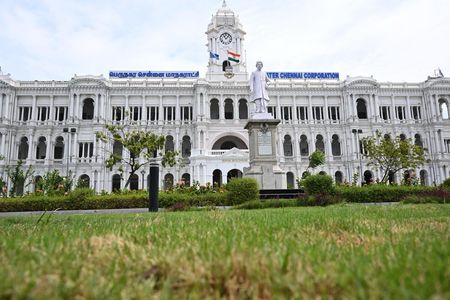
The Greater Chennai Corporation (GCC) council is scheduled to convene on Wednesday after a four-month pause due to the Assembly elections and the Model Code of Conduct. This meeting is anticipated to attract attention from residents and political observers alike. Citizens are hopeful that their long-pending civic issues will be addressed by their elected representatives, while political circles are monitoring developments such as councillors shifting to the ruling Tamizhaga Vettri Kazhagam (TVK) and discussions on displaying Chief Minister C. Joseph Vijay’s portrait in the council hall.
Four councillors from the AIADMK and Amma Makkal Munnetra Kazhagam (AMMK) have reportedly switched allegiance to the TVK in recent months. The TVK is supported in the council by its allies, including members from various parties. However, the DMK remains the dominant party in the council with 153 members.
R. Jayaraman, a CPI(M) councillor, highlighted that the lack of council meetings for four months has restricted opportunities for councillors to address public concerns. Residents have raised issues like power outages, unfinished stormwater drain works, poor road conditions, and irregular drinking water supply through tanker services.
DMK councillor Nethaji U. Ganesan praised the initiation of work on a long-pending road overbridge at a railway level crossing in North Chennai. However, he criticized the civic administration and police for implementing traffic diversions without consulting local councillors, leading to severe congestion during peak hours. Ganesan plans to propose alternative solutions during the upcoming meeting.
Valasaravakkam Zonal Chairman V. Rajan questioned the delay in council meetings, emphasizing that the election code had been lifted earlier. Corporation officials disclosed that 28 resolutions and 12 questions from councillors will be presented during the meeting. They also clarified that no formal communication has been received regarding councillors changing political affiliations, noting that such switches do not lead to automatic disqualification if proper intimation is provided.
