


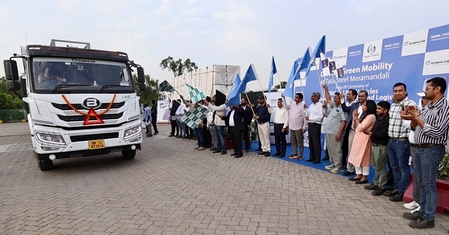
GreenLine Mobility Solutions Ltd., a pioneer in green logistics and an Essar venture, has enhanced its partnership with Tata Steel by launching LNG-powered trucks at Tata Steel’s Meramandali facility in Odisha. This move signifies a progression in their joint efforts to decarbonize long-haul road logistics at various operational sites in India. The collaboration underscores a mutual commitment to promoting cleaner fuel alternatives and cutting down carbon emissions from large-scale freight operations.
With a fleet of over 1,000 LNG- and EV-powered trucks operating along major freight routes in sectors like steel, cement, mining, FMCG, and chemicals, GreenLine has already covered more than 90 million kilometers. This substantial mileage has contributed to a reduction of over 24,000 tonnes of carbon dioxide emissions.
In line with its long-term strategy to advance clean freight mobility in the nation, GreenLine aims to deploy more than 10,000 LNG and EV trucks. This deployment will be supported by a network of 100 LNG refueling stations, EV charging hubs, and battery-swapping facilities across the country. The overarching goal is to slash 1 million tonnes of carbon emissions annually.
Madhur Taneja, the CEO of GreenLine Mobility Solutions Ltd., expressed satisfaction with the strengthened collaboration with Tata Steel through this deployment. He highlighted LNG as an increasingly viable and scalable alternative for long-haul logistics in India amid rising concerns about fuel dependency and energy security. Taneja emphasized that the transition to greener logistics will gain momentum as more industries embrace cleaner transportation solutions on a large scale.
Prabhat Kumar, Vice President Supply Chain at Tata Steel, acknowledged the indispensable role of partners like GreenLine in Tata Steel’s efforts to green its vehicles and logistics. Kumar emphasized the crucial support and coordination required from partners to achieve sustainability goals, thanking GreenLine for its contributions.
GreenLine’s LNG-powered trucks offer a driving range of up to 1,200 km on a single fill and up to 2,400 km with dual tanks. These trucks reduce carbon dioxide emissions by up to 40% compared to traditional diesel trucks, while also significantly cutting down particulate matter, SOx, NOx, and CO emissions.
