


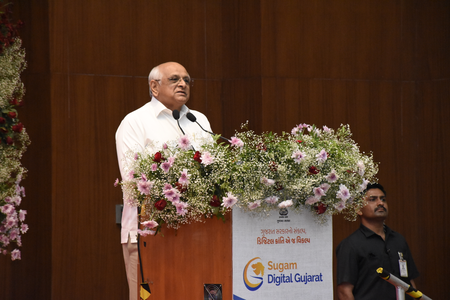
Gujarat Chief Minister Bhupendra Patel highlighted the aim of digital reforms to simplify citizens’ tasks, aiming for enhanced satisfaction within the system. The ‘Sugam Digital Gujarat’ initiative was formally introduced in Gandhinagar to modernize public services and shift them online for easier access. This move aligns with Prime Minister Narendra Modi’s vision for a developed India, as per the Chief Minister.
The program’s launch involved transitioning high-volume public services to online platforms, with 20 key services from five departments now accessible online. These services, such as income certificates and ration cards, will be digitized to eliminate the need for physical visits to government offices. CM Patel emphasized the importance of these initiatives in ensuring that eligible citizens benefit fully from government schemes.
CM Patel also stressed the role of local officials in facilitating citizens’ access to online services, emphasizing the benefits of promoting digital accessibility. He underlined the significance of collaboration among citizens, officials, and representatives for effective outcomes. The Chief Minister praised citizens’ cooperation in embracing digital payments, ensuring stable fuel availability in the state and addressing any potential shortages.
Science and Technology Minister Arjun Modhwadia hailed digitization as a valuable asset in present-day India and Gujarat, acknowledging past efforts to bridge the gap between citizens and the government. Chief Secretary Manoj Kumar Das emphasized the government’s commitment to reducing queues in offices, ensuring swift and efficient service delivery through technology. The newly introduced Sugam Digital Gujarat platform offers citizens the convenience of completing forms from home, with authentication based on barcodes and Aadhaar for up to one million users simultaneously.
The introduction of a digital locker system was also announced by the Chief Minister to streamline services and eliminate the need for repeated document submissions. This system aims to extend technology benefits to every citizen, enhancing transparency and efficiency in services like ration distribution and student scholarships.
