


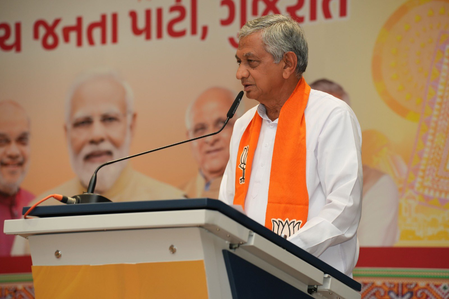
Emphasizing the importance of village transformation for India’s long-term development, Gujarat’s Rural Development Minister Kunvarji Bavaliya highlighted the need for villages to become vibrant economic centers to achieve the vision of “Viksit Bharat@2047.” Chairing a review meeting in Gandhinagar, the Minister focused on assessing the progress of key rural development schemes in the state, including Pradhan Mantri Awas Yojana–Gramin (PMAY-G), Swachh Bharat Mission–Gramin (SBM-G), and the Mahatma Gandhi National Rural Employment Guarantee Act (MGNREGA). The meeting aimed to review the physical and financial status, quality, and timelines of projects at the village level.
Highlighting Prime Minister Narendra Modi’s vision of Viksit Bharat@2047, Minister Bavaliya stressed the necessity of developing villages with modern infrastructure, essential amenities, and an improved quality of life akin to cities. He emphasized the importance of adopting an innovative lifestyle approach to enhance rural self-reliance, productivity, and economic dynamism. The Minister emphasized the urgency for villages to have urban-like facilities and for rural development projects to be completed efficiently, with quality and durability.
During the meeting, the Minister directed officials to ensure that all citizens, even in remote areas, are included in the development process. He emphasized the importance of meeting government-set physical and financial targets within specified timelines through effective planning and coordination. Senior officials, including Rural Development Department Additional Chief Secretary Dhananjay Dwivedi, Additional Commissioner of Panchayat, Rural Housing and Rural Development B.M. Prajapati, and district-level officers, attended the review meeting.
Villages in Gujarat, ranging from arid regions like Kutch to fertile areas in north and central Gujarat, coastal villages in Saurashtra, and tribal-dominated eastern districts, play a vital role in the state’s economy through various sectors such as agriculture, dairy farming, fisheries, handicrafts, salt production, and small-scale rural industries. Despite challenges like water scarcity and limited non-farm employment, Gujarat’s rural areas have seen progress in road connectivity, electrification, water supply, sanitation, digital services, and rural housing schemes. The focus on skill development, women-led enterprises, renewable energy, and village-level infrastructure is gradually transforming Gujarat’s villages into hubs of local economic activity and social empowerment, aligning with the state’s broader development vision.
