


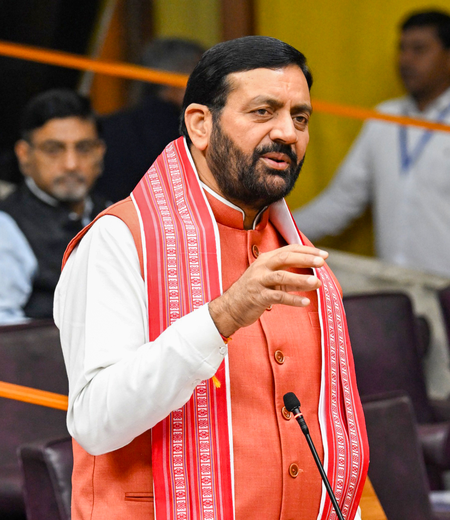
Haryana Chief Minister Nayab Singh Saini revealed a series of key decisions in the Assembly to enhance urban infrastructure and enhance citizens’ quality of life. This includes endorsing the final alignment of the Gurugram-Faridabad-Noida-Greater Noida Namo Bharat RRTS-cum-Metro corridor. The Chief Minister emphasized the government’s dedication to offering secure, contemporary, and effective public transportation facilities, marking this initiative as a significant move to bolster Haryana’s urban transport network.
At a recent meeting, the government greenlit the proposed corridor’s final alignment, with the detailed project report currently in the finalization stage. The National Capital Region Transport Corporation (NCRTC), the executing agency for the project, has received directives in this regard. Aligned with Prime Minister Narendra Modi’s vision under the “Namo Bharat” campaign, the project aims to link major economic centers through rapid, secure, and modern transportation systems.
The planned corridor is set to cover around 64 km, with nearly 52 km falling within Haryana’s borders. It is not just a rail corridor but a comprehensive regional mobility network connecting significant economic hubs like Gurugram, Faridabad, and Noida within the National Capital Region (NCR). The corridor’s objective is to offer swift connectivity to numerous commuters, alleviate traffic congestion, and promote environmental sustainability.
In the Gurugram section, approval has been granted for an integrated RRTS and Metro corridor spanning about 14.5 km from IFFCO Chowk to Gwal Pahari. This segment will facilitate connectivity with various metro lines, fostering seamless multi-modal integration. Similarly, in Faridabad, an integrated corridor of approximately 16 km from Sainik Colony to Badshahpur has been given the go-ahead, enhancing regional connectivity and supporting industrial and residential expansion.
The Chief Minister highlighted the project’s dual focus on infrastructure enhancement and environmental sustainability. Noise barriers will be erected along urban viaduct sections to curb sound pollution and enhance the living conditions of nearby communities. The initiative is expected to attract investments, create jobs, and foster balanced urban growth across Haryana, catering to the escalating population and traffic challenges in cities like Gurugram and Faridabad.
