


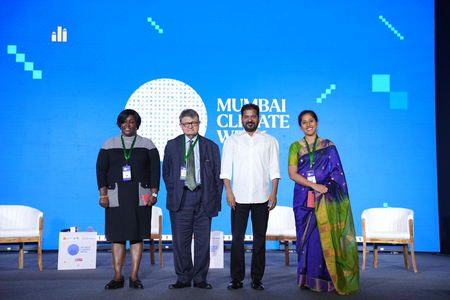
Telangana Chief Minister A. Revanth Reddy revealed Hyderabad’s goal to achieve Net Zero by 2034 and announced an upcoming city-wide carbon footprint audit. Within the next five years, the urban area will see minimal presence of industries or factories. At the Mumbai Climate Week, the Chief Minister shared Telangana’s vision of sustainable development, aiming to link economic growth with environmental responsibility.
He emphasized Telangana’s aspiration to elevate its state GDP from 200 billion dollars to a one-trillion-dollar economy by 2034 and a three-trillion-dollar economy by 2047. The strategic framework for development in Telangana is divided into three zones – CURE, PURE, and RARE. Hyderabad has been designated as the Core Urban Region Economy (CURE) within the 160-kilometer Outer Ring Road. The PURE Zone, situated between the Outer Ring Road and the 360-kilometer Regional Ring Road, is focused on manufacturing and positioned as a significant hub powered by green energy.
The Chief Minister highlighted the impact of Covid and climate change, noting a shift in governmental approaches and labeling the current situation as a climate emergency. He stressed the importance of maintaining growth, investments, and job creation while prioritizing sustainability. In Hyderabad, taxes on electric vehicles have been eliminated, leading to increased adoption of EVs. Discussions are ongoing with EV companies for manufacturing investments.
More than 200,000 auto-rickshaws are being converted to green alternatives, while over 3,500 RTC buses are being replaced with electric buses. The Hyderabad Metro’s expansion from 71 kilometers to over 200 kilometers is underway, and industries are gradually being relocated from the core urban region to peri-urban zones. The Chief Minister underscored the significance of power in an economy, stating that development is gauged by power generation and consumption.
Telangana presently consumes an average of 16,610 megawatts daily, with a peak demand of 17,162 megawatts last year. The state anticipates this demand to surpass 19,000 megawatts this year and exceed 34,000 megawatts by 2034 as it aims for a one-trillion-dollar economy. Approximately 24.8% of the state’s energy is sourced from green power. The Chief Minister highlighted sustainability projects such as the rejuvenation of River Musi, lake restoration, enhancement of water and energy grids, and the establishment of HYDRAA, India’s first dedicated environmental police force.
