


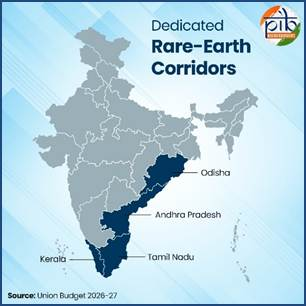
India is making strategic moves to establish itself as a competitive player in advanced materials value chains, aiming for self-reliance in critical materials. The country has launched a Rs 7,280 crore scheme for Rare Earth Permanent Magnets (REPMs) manufacturing and announced the creation of Dedicated Rare Earth Corridors in various states in the Union Budget 2026–27. These initiatives form an integrated framework for mining, processing, research, and manufacturing of rare earth materials.
The Rare Earth Permanent Magnets (REPMs) are highly potent permanent magnets known for their exceptional magnetic strength and stability. These magnets are crucial for various advanced applications such as electric vehicle motors, wind turbine generators, consumer electronics, aerospace systems, and defense equipment due to their compact size and powerful performance. India’s significant reserve of rare-earth minerals, including 13.15 million tonnes of monazite, provides a solid foundation for industries like REPM manufacturing.
India’s rare-earth mineral deposits are spread across states like Odisha, Kerala, Andhra Pradesh, Tamil Nadu, West Bengal, Gujarat, Maharashtra, and Jharkhand, primarily in coastal beach sands, teri/red sands, and inland alluvium. The Geological Survey of India (GSI) has identified substantial rare-earth ore resources in exploration projects, totaling 482.6 million tonnes. Despite the rich rare-earth resource base, India’s domestic production of permanent magnets is still in the nascent stage, with a significant portion of demand being met through imports from China.
The consumption of Rare Earth Permanent Magnets is projected to double by 2030, driven by the rapid growth in sectors like electric mobility, renewable energy, electronics, and defense applications. To reduce import dependence and ensure long-term self-reliance, India needs to enhance its domestic manufacturing capabilities and invest in the sector.
