


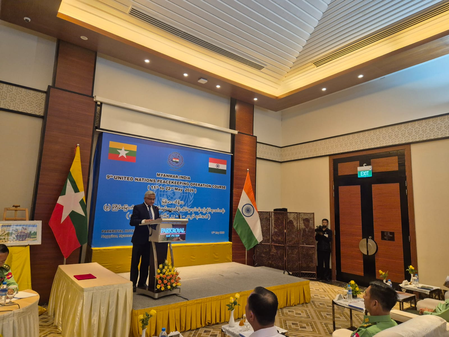
The Centre for United Nations Peacekeeping from New Delhi has initiated a two-week United Nations Peacekeeping Operations course for 30 Myanmar officers in Naypyitaw. This marks the 9th such course between India and Myanmar, with a training team from the Centre conducting the sessions. Ambassador Abhay Thakur highlighted India’s role in global stability through humanitarian missions during the course commencement.
Last year, the 8th training capsule was conducted, building on previous successful courses held between 2016 and 2019. The Ambassador emphasized the deep-rooted bond between Myanmar and India, based on shared history, cultural exchanges, and geographical proximity.
Myanmar’s strategic importance to India was underscored by the Ambassador, noting its alignment with India’s key foreign policy priorities. The relationship between the two nations was described as a testament to their shared destiny and future.
A comprehensive curriculum focusing on enhancing the readiness and understanding of Myanmar officers in critical areas has been designed. The training covers topics such as graduated escalation, conflict management, rules of engagement, and protection of civilians.
The curriculum also includes operational planning within complex peacekeeping environments, offering practical insights for effective mission execution. India’s significant contributions to global peace and security, with a history of over 2,90,000 peacekeepers in 50 UN Missions since 1950, were highlighted.
The Centre for United Nations Peacekeeping, established as a collaborative effort of the Ministry of External Affairs, Ministry of Defence, and the Armed Forces, plays a crucial role in training initiatives. India’s active participation in UN peacekeeping debates and its influence on shaping peacekeeping strategies were acknowledged.
