


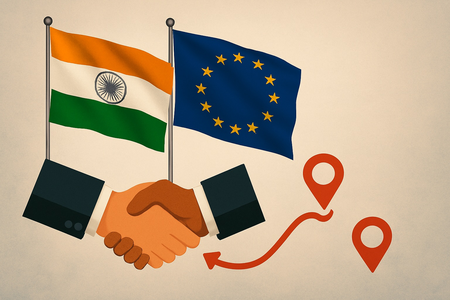
The recently signed Free Trade Agreement between India and the European Union has sparked optimism among textile traders in Surat, a key textile hub in India. This agreement, finalized on Tuesday, is set to enhance exports for Indian textile products by granting them improved access to markets across 27 European countries. Surat-based traders anticipate increased sales and better profit margins as the FTA enables them to offer products in Europe at more competitive prices.
Industry experts note that the FTA will lead to a reduction or elimination of tariffs on 96.6% of European goods entering India, while Indian textile exports to Europe will benefit from tariff concessions, enhancing their competitiveness in the market. Kailash Hakim, President of the Federation of Textile and Trade Associations in Surat, highlighted that this agreement will help offset losses faced due to higher tariffs in the US market.
Acknowledging the positive impact of the FTA, Sushil Gupta, a textile trader from Surat, emphasized that it will bolster India’s export position and bring stability to the industry in the long run. He also mentioned that the improved market access in Europe will enable traders to expand their operations and forge new international partnerships.
Johnny Rathod, another textile trader from Surat, expressed that the FTA will promote the adoption of high-quality European machinery, potentially replacing Chinese equipment and enhancing production standards. He described this agreement as a significant boost for the textile industry, especially for hubs like Surat that drive India’s textile exports.
European Commission President Ursula von der Leyen hailed the agreement as “the mother of all deals,” while Indian Prime Minister Narendra Modi termed it as “historic.” The pact encompasses substantial tariff reductions, including the phased elimination of duties on various EU exports like chemicals, machinery, and aircraft. Additionally, import duties on motor vehicles from the EU will see a significant drop, benefiting from a reduced rate of 10% under a quota of 250,000 vehicles.
India, on its part, will also slash tariffs on EU products such as wine, beer, and olive oil. Apart from trade provisions, the agreement includes a joint security partnership and is anticipated to enhance investment flows, bolster market access, and strengthen supply-chain integration between India and the EU.
