


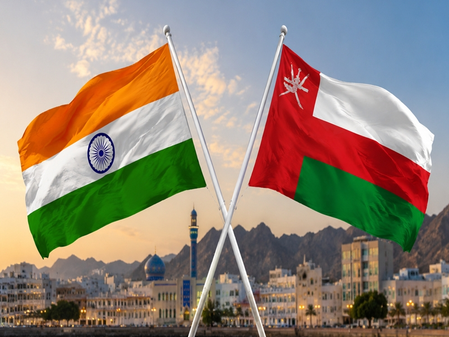
India and Oman’s Comprehensive Economic Partnership Agreement (CEPA) goes beyond trade, providing strategic benefits by offering alternatives to the risks associated with the Strait of Hormuz, according to a report by India Narrative. Oman’s geographical location near the Hormuz choke point and its port infrastructure offer India additional maritime access points, reducing reliance on a single corridor. This engagement enables India to connect with open sea routes and enhance its connectivity in the Indian Ocean region.
The CEPA allows India to diversify its supply routes and establish stronger links with Gulf markets, East Africa, North Africa, and parts of Central Asia through Oman. Furthermore, the agreement focuses on energy security through institutionalization rather than mere trade expansion. India and Oman already share a robust trade relationship in sectors like hydrocarbons, LNG, fertilizers, and petrochemicals, and the CEPA aims to provide a more stable framework for investments and supply agreements.
Under the CEPA, Oman grants 100% duty-free market access to 98% of tariff lines, covering 99.38% of India’s exports to the Omani market. This is a significant increase from the previous system, which offered zero-duty access to only 15.3% of India’s exports. The agreement is expected to benefit sectors like iron and steel, textiles, leather, auto components, and industrial equipment, particularly small businesses, by opening up opportunities for large international orders.
Union Commerce and Industry Minister Piyush Goyal highlighted the potential for increased textile exports to Oman, which could stimulate production and job creation in key clusters across India. This move is expected to benefit artisans and weavers in regions like Tirupur, Surat, Ludhiana, Panipat, Coimbatore, Karur, Moradabad, Jaipur, and Ahmedabad, as international demand for their products is likely to rise.
