


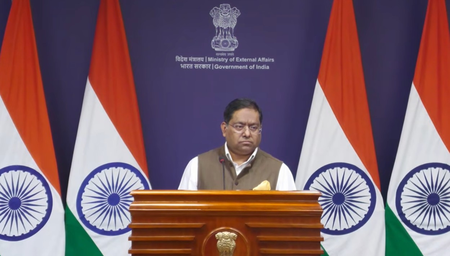
India firmly addressed Nepal Prime Minister Balendra Shah’s comments on boundary issues, emphasizing that no third party should intervene in matters between the two nations. The Ministry of External Affairs spokesperson, Randhir Jaiswal, highlighted that while almost 98% of the India-Nepal boundary has been demarcated, some segments remain unresolved due to factors like the shifting course of the Gandak River.
Jaiswal stated that cases of cross-border occupation and encroachment in demarcated areas are being jointly mapped, with bilateral mechanisms in place to handle boundary matters comprehensively. He reiterated that third parties have no role to play in the bilateral affairs of India and Nepal, responding to Shah’s recent claims of territorial encroachment by both countries.
Shah’s remarks came after allegations of Nepal encroaching on Indian land, without specifying the locations. The disputed regions of Limpiyadhura, Lipulek, and Kalapani have been subject to sovereignty claims by both nations, with the area largely under Indian control. Shah also mentioned diplomatic discussions with China and the UK on the border dispute, a move that drew criticism from various quarters in Nepal for potentially weakening the country’s stance in future negotiations with India.
Nepal’s Foreign Ministry clarified that the Prime Minister’s comments were related to technical studies in border areas where citizens from one country use land falling within the other’s territory. The statement highlighted the complexities arising from the “Fixed Boundary Principle” in river boundary regions, where citizens from both countries may cultivate or reside on technically opposite sides of the border.
