


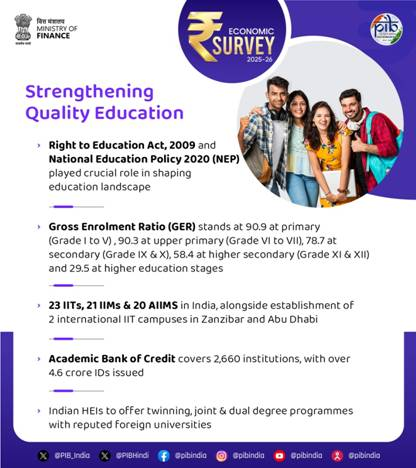
India’s Economic Survey 2025-26, presented in Parliament by Finance Minister Nirmala Sitharaman, acknowledges significant advancements in school enrollment and higher education institutions. The progress is attributed to improved infrastructure and teacher capabilities, supported by initiatives like the Right to Education Act 2009 and the National Education Policy 2020 (NEP).
The survey outlines various measures contributing to these achievements, including updated UGC guidelines, regulations for academic partnerships, and recognition of qualifications. It also mentions permissions granted for foreign branch campuses, including those in GIFT City, indicating a positive trend in educational development.
Notable improvements in literacy rates, school enrollments, and vocational education opportunities have been observed. The Right to Education Act 2009 and NEP 2020 have been instrumental in enhancing educational access, ensuring equity, and fostering innovation in teaching and learning methodologies.
India’s education landscape has witnessed enhanced school enrollment through initiatives like Poshan Shakti Nirman and Samagra Shiksha Abhiyan, aimed at promoting inclusivity and accessibility. The Gross Enrolment Ratio (GER) stands at encouraging levels across different educational stages, reflecting a positive trajectory in educational participation.
The survey also highlights a substantial rise in the number of higher education institutions (HEIs) from 51,534 in 2014-15 to 70,018 by June 2025. This growth is particularly notable in universities and colleges, indicating a broader spectrum of educational opportunities for students.
The expansion of premier HEIs, including 23 IITs, 21 IIMs, and 20 AIIMS, showcases the country’s commitment to fostering excellence in higher education. Additionally, the establishment of international IIT campuses in Zanzibar and Abu Dhabi underscores India’s global educational outreach and collaborations.
According to the All-India Survey on Higher Education (AISHE) 2022-23 (Provisional), student enrollment has increased from 4.33 crore in 2021-22 to 4.46 crore in 2022-23, reflecting a growing interest in pursuing higher education among Indian youth.
The survey emphasizes the need for sustained focus on the education sector to unleash India’s full potential through robust policy frameworks. It advocates for a comprehensive approach, aligning with NEP’s schooling structure, to elevate the Expected Years of Schooling (EYS) to 15 years, ensuring a skilled and adaptable workforce for the future.
