
Close Menu
  • Indian Festivals 2026
  • Movie & OTT Releases This Week
  • News
  • Entertainment
  • NRI Life
  • Research
  • Advertise with us
Facebook X (Twitter) Instagram YouTube
  • Download Indian Community App
  • Advertise Here
Facebook X (Twitter) Instagram
Indian CommunityIndian Community
Trending
  • Narasimha Jayanti Prayers: Mahamantra, Katha & Aarti
  • Vada Pappu for Narasimha Jayanti – The Sacred No-Cook Moong Dal Prasadam That Asks Almost Nothing of You
  • Neer Mor Recipe — The Chilled Spiced Buttermilk That Completes the Narasimha Jayanti Thali
  • Phula (2026) Movie Review: A Soulful Tale of Resilience and Folk Art
  • Therachaapa Movie Review: A Rooted Rustic Drama Packed With Emotion and Grit
  • Salbardi (2026) Review: A Gripping Tale of Mystery and Justice From the Heartland
  • Bad Boy Karthik Review (2026): A Brother’s Fight That Packs Enough Heart to Win You Over
  • Matka King Review: Vijay Varma’s Finest Hour in a Gripping Bombay Crime Drama
  • Indian Festivals 2026
  • News
    • National
    • International
    • Entertainment
    • Achievements
    • Scam Alerts
    • Business
    • Health & Medicine
    • Science & Technology
    • Sports
  • Entertainment
  • Latest Movie Releases
    • Latest OTT Releases
  • NRI Life
  • India & Culture
  • Health & Wellness
  • Research
Indian CommunityIndian Community
Home » News » Science/Tech
Science/Tech

India Sees Progress in Education Sector, Economic Survey Highlights

Indian Community Editorial TeamBy Indian Community Editorial TeamJanuary 29, 20262 Mins ReadNo Comments Add us to Google Preferred Sources
India Sees Progress in Education Sector, Economic Survey Highlights
Share
Facebook Twitter LinkedIn Pinterest Email

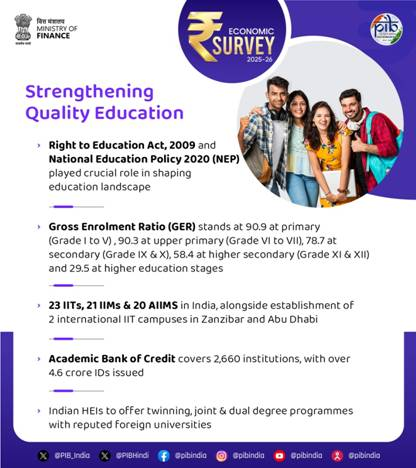
India’s Economic Survey 2025-26, presented in Parliament by Finance Minister Nirmala Sitharaman, acknowledges significant advancements in school enrollment and higher education institutions. The progress is attributed to improved infrastructure and teacher capabilities, supported by initiatives like the Right to Education Act 2009 and the National Education Policy 2020 (NEP).

The survey outlines various measures contributing to these achievements, including updated UGC guidelines, regulations for academic partnerships, and recognition of qualifications. It also mentions permissions granted for foreign branch campuses, including those in GIFT City, indicating a positive trend in educational development.

Notable improvements in literacy rates, school enrollments, and vocational education opportunities have been observed. The Right to Education Act 2009 and NEP 2020 have been instrumental in enhancing educational access, ensuring equity, and fostering innovation in teaching and learning methodologies.

India’s education landscape has witnessed enhanced school enrollment through initiatives like Poshan Shakti Nirman and Samagra Shiksha Abhiyan, aimed at promoting inclusivity and accessibility. The Gross Enrolment Ratio (GER) stands at encouraging levels across different educational stages, reflecting a positive trajectory in educational participation.

The survey also highlights a substantial rise in the number of higher education institutions (HEIs) from 51,534 in 2014-15 to 70,018 by June 2025. This growth is particularly notable in universities and colleges, indicating a broader spectrum of educational opportunities for students.

The expansion of premier HEIs, including 23 IITs, 21 IIMs, and 20 AIIMS, showcases the country’s commitment to fostering excellence in higher education. Additionally, the establishment of international IIT campuses in Zanzibar and Abu Dhabi underscores India’s global educational outreach and collaborations.

According to the All-India Survey on Higher Education (AISHE) 2022-23 (Provisional), student enrollment has increased from 4.33 crore in 2021-22 to 4.46 crore in 2022-23, reflecting a growing interest in pursuing higher education among Indian youth.

The survey emphasizes the need for sustained focus on the education sector to unleash India’s full potential through robust policy frameworks. It advocates for a comprehensive approach, aligning with NEP’s schooling structure, to elevate the Expected Years of Schooling (EYS) to 15 years, ensuring a skilled and adaptable workforce for the future.

Abu Dhabi AIIMS AISHE Expected Years of Schooling GIFT City Gross Enrolment Ratio HEIs IIMs IITs India National Education Policy 2020 NEP Nirmala Sitharaman Right to Education Act 2009 UGC Zanzibar
Add us to Google Preferred Sources
Indian Community Editorial Team

The Indian Community Editorial Team curates, verifies, and publishes stories that matter to Indians worldwide. From culture and community to business and innovation, our mission is to spotlight voices, ideas, and events that bring our global community closer together. Have news or a story to share? Submit it to us at [email protected].

Related Posts

India-EU and India-UK Free Trade Agreements: What They Really Mean for Indian Immigration

Canada PR for Indians 2026: 4 Critical Steps to Secure Permanent Residency Through Express Entry

H-1B Visa Interview Appointments for Indians Pushed to 2027: What You Need to Know Now

Add A Comment
find baby names

Harman Sachdeva and Jamal Hossain Lead DP World Players Championship

April 21, 2026

Congress MP Sends Legal Notice Over Docu-Series ‘Lawrence of Punjab’

April 21, 2026

Karnataka BJP Leader Criticizes Congress President for Calling PM Modi “Terrorist”

April 21, 2026

Jammu and Kashmir L-G Emphasizes National Development Goals

April 21, 2026
  • Facebook
  • Twitter
  • Pinterest
  • Instagram
About Us
  • About Us
  • Contact Us
  • Terms of Service
Corporate
  • Download Indian Community App
  • Advertise Here
Facebook X (Twitter) Instagram
  • About Us
  • Contact Us
  • Terms of Service
© 2026 Designed by CreativeMerchants.

Type above and press Enter to search. Press Esc to cancel.