


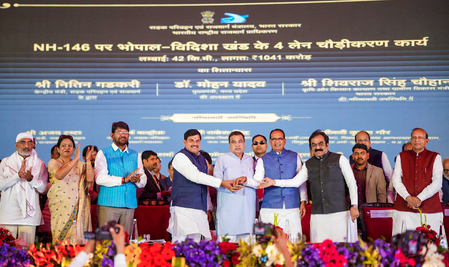
Union Minister for Road Transport and Highways Nitin Gadkari, speaking in Madhya Pradesh’s Vidisha district, highlighted India’s commitment to converting agricultural waste into valuable resources. He announced plans to produce bitumen from farm residues like sugarcane bagasse, emphasizing the evolving role of farmers as energy and material suppliers. India has achieved a significant milestone by becoming the first nation to commercially produce bio-bitumen, an eco-friendly alternative to petroleum-based bitumen, through innovative technologies like pyrolysis.
Bitumen, also known as “Damar” locally, is being produced from agri-waste following a technology transfer ceremony in New Delhi on January 7, 2026. Gadkari mentioned that 15 companies have acquired patents for producing bitumen from agricultural waste such as cotton straw, bagasse, and wheat straw. This initiative is aligned with broader sustainability objectives and aims to reduce import dependence, lower carbon emissions, and create new revenue streams for rural communities.
The bio-bitumen project seeks to address a portion of India’s bitumen demand, which is predominantly met through imports, by utilizing abundant agricultural by-products like sugarcane bagasse and rice straw. It is estimated that this initiative could lead to significant foreign exchange savings, reduced stubble burning, and up to 70% lower emissions compared to traditional bitumen. Pilot projects have demonstrated comparable performance in road construction, emphasizing environmental benefits such as reduced pollution and improved waste management.
Nitin Gadkari commended the efforts under Prime Minister Narendra Modi’s leadership and urged the increased adoption of bio-materials in road infrastructure development. This announcement builds upon CSIR’s “From Farm Residue to Road: Bio-Bitumen via Pyrolysis” technology, which has garnered industry support and successful trial implementations. By integrating agriculture, industry, and green infrastructure, India aims to achieve its net-zero emissions target by 2070 and the Viksit Bharat 2047 vision, showcasing the potential of waste-to-wealth initiatives in sustainable development.
