


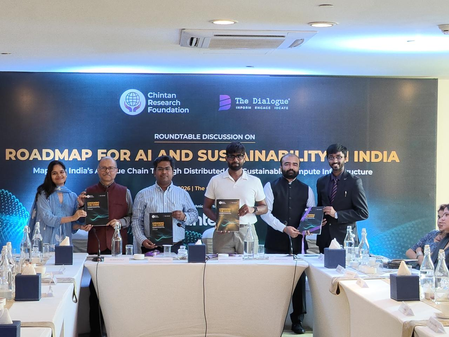
India’s artificial intelligence (AI) roadmap should prioritize affordability and accessibility, according to Ravi Shankar Prajapati, Joint Director at the Bureau of Energy Efficiency. Prajapati emphasized this during a policy roundtable titled “Roadmap for AI and Sustainability in India,” organized by Chintan Research Foundation in collaboration with The Dialogue. He highlighted that India’s AI aspirations are at a critical juncture, given its significant data generation capabilities.
The future of AI in India will not only be influenced by algorithms and applications but also by the infrastructure supporting large-scale computation, including its design, location, and sustainability. The discussion at the event, which brought together policymakers, experts, and industry stakeholders, focused on aligning AI growth with sustainability objectives. Dr. Debajit Palit, Centre Head at the Centre for Climate Change and Energy Transition at CRF, stressed the importance of balancing energy and AI for India’s progress.
Shreeppriya Gopalakrishnan, DGM Policy at IndiaAI under the Ministry of Electronics and IT, highlighted the need to view AI infrastructure as an interconnected ecosystem encompassing hardware, software, data, energy, and institutional frameworks. She emphasized the necessity of adopting a comprehensive approach that connects AI goals with real-world resource limitations. Participants agreed that data centers and AI-ready computing capacity should be considered strategic infrastructure rather than peripheral digital assets, with significant implications for energy systems, regional development, digital sovereignty, and long-term economic growth.
Experts identified various structural challenges that could impact India’s AI journey, such as data center concentration in major cities, limited grid capacity, water scarcity, climate risks, and increasing energy demands. Overcoming these obstacles will be vital for the sustainable scaling of AI across the country.
