


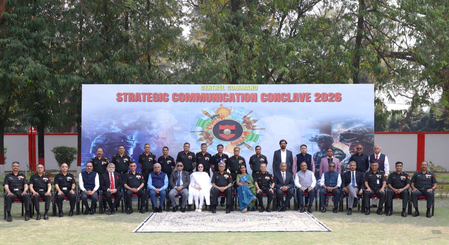
The Indian Army’s Central Command organized its inaugural Strategic Communication Conclave in Lucknow to address the evolving nature of warfare and the importance of perception management. With nearly 500 attendees, the event focused on strategic communication’s role in national security and featured discussions on doctrine, structures, and preparedness in the modern information landscape. The conclave brought together senior diplomats, government communication experts, media personnel, and military officials to delve into the strategic communication within the national security framework.
In his opening speech, Lt Gen Anindya Sengupta, the General Officer Commanding-in-Chief of Central Command, emphasized the significant shift in warfare, now encompassing information and cognitive domains. He highlighted the criticality of perception management, linking perception to legitimacy, influence, and outcomes, while also addressing the weaponization of narratives and the threats posed by conflicts below the war threshold. Lt Gen Sengupta stressed the need for strategic communication to move beyond reactive and personality-driven approaches to become institutionalized, doctrine-backed, and capability-driven.
The conclave featured a policy-level session focusing on institutionalizing strategic communication for future preparedness in the emerging information space. Notable speakers like Ambassador Ruchira Kamboj, Ambassador Yashvardhan Sinha, and Lt Gen Raj Shukla shared insights during this session. Additionally, a special interactive segment explored strategic communication in emerging multi-domain operations, integrating policy and operational viewpoints. Retired civil and military officials, including Ambassador Dilip Sinha, Shantanu Mukharji, Veena Jain, and Lt Gen DP Pandey, provided valuable perspectives during the discussions. Panel talks with media professionals centered on themes like ‘Perception Management in the Strategic Domain’ and ‘Information Power and Strategic Communication,’ underlining the significance of managing perceptions and leveraging information power.
