


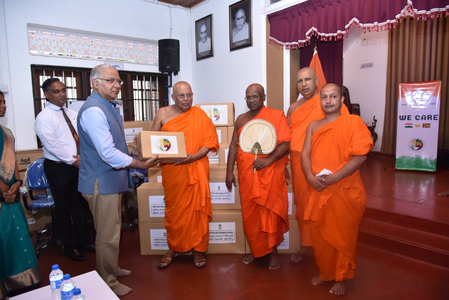
The High Commissioner of India to Sri Lanka recently provided IT equipment and accessories to the Pirivena at Sri Welagamba Mahapirivena in Dambulla, a revered cave temple in Sri Lanka. This initiative aims to enhance traditional Buddhist education by incorporating modern technology and methods. The High Commissioner emphasized the strong bond between India and Sri Lanka in promoting Buddhist heritage and values.
The High Commissioner also extended support to the fishermen community in Jaffna by offering Indian assistance in the Kayts division. He briefed them on various Indian initiatives in the fisheries sector, including the development of infrastructure such as the Point Pedro harbor and Karainagar boatyard. Additionally, training opportunities for fishermen and the provision of motorbikes to fisheries officials were discussed to improve coastal livelihoods.
In another engagement, the High Commissioner visited the Passenger Ferry service operating between Nagapattinam in India and Kankesanthurai (KKS) in Sri Lanka. To ensure operational sustainability, India is providing Viability Gap Funding amounting to over LKR 300 million annually for the ferry’s operation. Discussions also revolved around the modernization project for the KKS harbor, for which India has pledged USD 61.5 million to boost regional trade and tourism.
Furthermore, the High Commissioner inaugurated a new RO water plant at the Nainathivu Nagapooshani Amman temple, emphasizing the importance of providing clean drinking water at major temples across the Northern Province. This initiative is part of a broader effort to address the everyday needs of local communities in Sri Lanka, reflecting India’s commitment to people-centric projects.
Lastly, the High Commissioner visited the Hybrid Renewable Energy Systems site on Delft Island, where a project integrating solar, wind, and battery storage with diesel backup is underway. Supported by India with a USD 11 million grant, this project aims to provide reliable and clean power to off-grid communities on islands off Jaffna. The first phase of operation is expected to commence by August this year, with full implementation anticipated before the end of 2026.
