


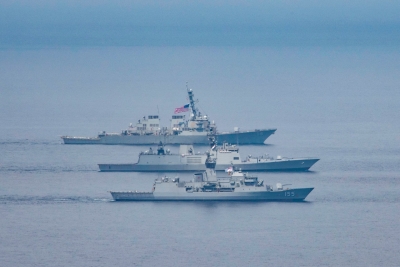
India’s role in the Indo-Pacific region has evolved significantly, shifting from a peripheral player to a crucial hub for regional stability and prosperity. A recent report highlights that India’s strategic significance in the Indo-Pacific is a result of continuous investments in maritime capabilities, diplomatic relations, and economic integration.
Three key factors are driving India’s rise in the Indo-Pacific: the need to counterbalance China’s regional dominance, the opportunity to align with democratic nations, and the economic imperative to diversify trade beyond South Asia. This transformation underscores India’s pivotal position in shaping the region’s future.
The Quadrilateral Security Dialogue (QUAD), involving India, the United States, Japan, and Australia, exemplifies India’s enhanced role. While part of QUAD, India maintains strategic autonomy, benefiting from security cooperation and technology transfer without compromising its foreign policy independence.
India’s Indo-Pacific strategy is anchored in the Security and Growth for All in the Region (SAGAR) framework, emphasizing freedom of navigation, capacity building, and adherence to international maritime laws. The recent IKIGAI Framework unveiled by Army Chief General Upendra Dwivedi signifies India’s strategic evolution in military cooperation across the Indo-Pacific.
India’s leadership in the Indo-Pacific is not guaranteed but must be continually earned through sustained investments in various domains. As India takes on key roles in organizations like the Indian Ocean Rim Association (IORA) and deepens defense partnerships, its approach of balancing autonomy with collaboration will shape the region’s governance in the years ahead.
