


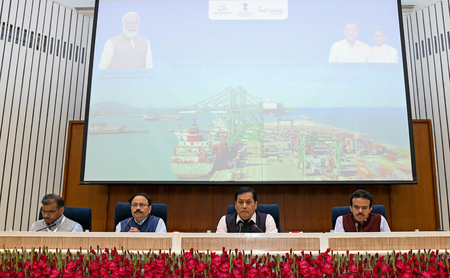
India’s maritime sector has witnessed significant growth in capacity, connectivity, and operational efficiency in the last decade, with the Sagarmala programme playing a key role in modernizing ports, developing coastal and inland waterway infrastructure, and enhancing cargo handling capabilities. The Sagarmala programme, spanning 11 years, has shown tangible results, with Sagarmala 2.0, backed by Rs 85,482 crore, aiming to attract investments totaling Rs 3.6 lakh crore.
Under the programme, approximately 845 projects valued at Rs 6.06 lakh crore have been initiated. As of March 24, 2026, 315 projects worth Rs 1.57 lakh crore have been completed, 210 are in progress, and 320 are in the planning phase. These completed projects have increased capacity, reduced vessel turnaround times, and supported industrial and community development, fostering sustained growth and fortifying India’s maritime infrastructure for trade.
India’s major ports collectively handled a record 915.17 million tonnes (MT) of cargo in FY 2025–26, surpassing the annual target of 904 MT, indicating a 7.06% year-on-year growth. Notably, the average vessel turnaround time has significantly decreased from 96 hours in 2014 to 49.5 hours in 2025, showcasing enhanced port efficiency and quicker cargo operations.
Furthermore, Indian ports have strengthened their global presence, with 9 ports ranking among the world’s top 100, including Visakhapatnam Port in the top 20 for container traffic. Inland waterway cargo movement surged from 18.10 MTPA in FY 2013–14 to 145.50 MTPA in FY 2024-25, a remarkable 700% growth, contributing to a more efficient logistics system.
Completing 11 fishing harbor projects at a cost of Rs 1,057 crore has directly benefited over 30,000 fishermen. Besides infrastructure enhancements, the Sagarmala Programme has focused on uplifting livelihoods in coastal communities through targeted skill development initiatives, estimating a potential of around 1 crore jobs, including 40 lakh direct and 60 lakh indirect employment opportunities, driven by port-led industrialization and maritime infrastructure expansion.
