


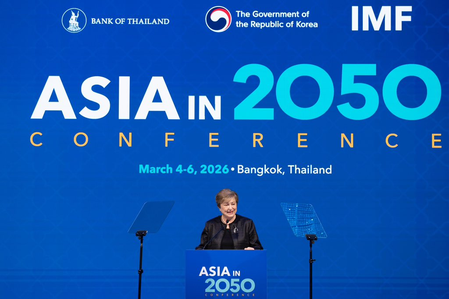
India is playing a significant role in the worldwide Artificial Intelligence (AI) revolution, according to Kristalina Georgieva, Managing Director of the International Monetary Fund. Speaking at the Asia in 2050 Conference in Bangkok, Georgieva emphasized that AI has the potential to reshape the global economy, with Asia at the forefront of this transformation.
Georgieva pointed out that AI could boost Asia’s economic growth by almost one percentage point annually if countries effectively leverage the technology to enhance productivity. She praised India for not only democratizing AI within its borders but also for extending this technology to numerous developing nations.
Highlighting India’s vast digital ecosystem, expanding technology industry, and youthful workforce, Georgieva noted that these factors could facilitate broader access to AI tools globally. However, she cautioned about the potential disruption AI could bring to labor markets in the region.
The IMF chief highlighted the possibility of increased demand for both high-skilled and low-skilled workers due to automation, while middle-level jobs might face challenges. She expressed concerns about the impact on entry-level positions, often involving routine tasks that are susceptible to automation, which could create uncertainties for new graduates entering the workforce.
To address these issues, Georgieva stressed the importance of government investments in digital infrastructure, enhancing skills training, and ensuring workers can adapt to evolving technologies. She underscored the significance of developing a flexible workforce and promoting continuous learning to harness the benefits of AI while mitigating associated risks.
Georgieva emphasized that nations proactively preparing and investing in their workforce will be better positioned to capitalize on AI-driven growth, whereas those delaying such actions risk lagging behind in the global economic landscape.
