


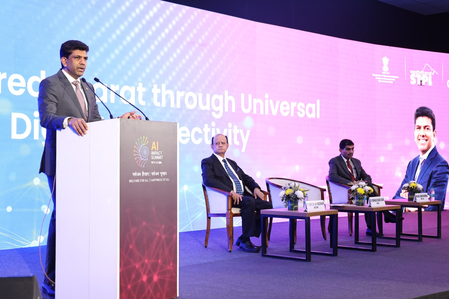
Telecom infrastructure is highlighted as the backbone of India’s AI ecosystem by Union Minister Dr. Pemmasani Chandrasekhar. He emphasized that connectivity is a necessity for the nation, not a luxury, underscoring the importance of inclusive digital connectivity for India’s technological advancement and digital empowerment. At the ‘India AI Impact Summit,’ he pointed out India’s significant progress in telecom growth, with broadband subscribers increasing from 6 crore in 2014 to 100 crore in 2025.
Focusing on the numbers, the minister mentioned that the average monthly mobile data consumption has surpassed 24 GB per user, with over 42 lakh route kilometers of fiber deployment and one of the fastest 5G rollouts globally in India. Investments in last-mile connectivity initiatives like BharatNet are ensuring that AI-enabled services are reaching rural and remote areas, making emerging technologies accessible to all. India is now transitioning from expanding connectivity to enhancing capabilities, with a specific focus on high-capacity fiber backhaul, edge computing, cloud infrastructure expansion, and affordable access to foster innovation in Tier-2 and Tier-3 cities.
Dr. Pemmasani noted the increasing adoption of AI across various sectors, with more large enterprises incorporating AI into their active production environments. He also highlighted the strengthened telecom security frameworks, including the AI-enabled Digital Intelligence Platform connecting over 1,200 institutions. Tools like ASTR have identified and disconnected over 86 lakh fraudulent SIM cards, while the Financial Fraud Risk Indicator has prevented fraudulent transactions worth over Rs 1,400 crore. The minister emphasized that telecom is now about connecting opportunities, not just calls, and reiterated India’s commitment to creating an inclusive, secure, and AI-ready digital future.
India’s status as one of the top global AI ecosystems and the world’s second-largest telecom market was also mentioned by the minister. He further highlighted the allocations under the IndiaAI Mission and significant investments in semiconductor manufacturing as part of the government’s strategy to develop a self-reliant and innovation-driven digital economy.
