


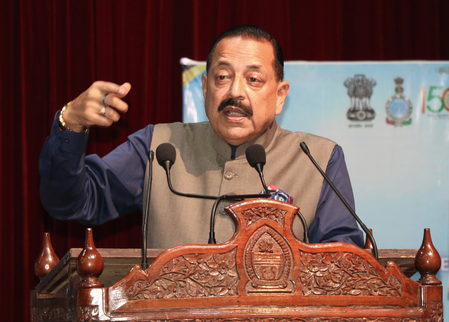
India’s first privately developed orbital launch vehicle, Vikram‑1, has achieved its designated low Earth orbit, marking a significant milestone for the country’s space ambitions. Union MoS, Science & Technology, Earth Sciences Dr. Jitendra Singh emphasized that this success underscores India’s growing stature as a key player in the global space arena. The Department of Space’s announcement highlighted the pivotal role of Prime Minister Narendra Modi’s decision to involve the private sector in the country’s space endeavors.
Mission Aagaman showcased the effectiveness of India’s public-private partnership model, showcasing the collaborative efforts of various entities including the Department of Space, ISRO, IN-SPACe, and the country’s thriving start-up ecosystem. Dr. Jitendra Singh credited Prime Minister Narendra Modi’s visionary move to open up India’s space sector to private players for enabling such groundbreaking achievements. The reforms initiated have unleashed the potential of Indian innovators, granting them access to national space infrastructure and fostering an environment conducive to developing cutting-edge technologies domestically.
Vikram-1’s successful mission demonstrated a high level of technological maturity, particularly noteworthy for a debut orbital launch. In a departure from conventional practices, Vikram‑1 carried experimental payloads and customer demonstrations from both Indian and international partners. This mission not only showcased India’s commercial launch capabilities but also reflected the growing trust of the global space community in the country’s prowess. Built entirely in India, Vikram‑1 boasts a capacity to deploy up to 350 kilograms into low Earth orbit and incorporates indigenous innovations such as an all-carbon composite orbital rocket and a 3D-printed liquid engine for its Orbital Adjustment Module.
The statement also highlighted India’s space sector reforms since 2020, which have fostered the growth of over 400 space startups, leading to the emergence of the first space unicorn and a burgeoning space economy nearing $9 billion. The national vision aims to expand this space economy to approximately $44 billion in the coming decade, signifying a significant leap in India’s space ambitions and capabilities.
