


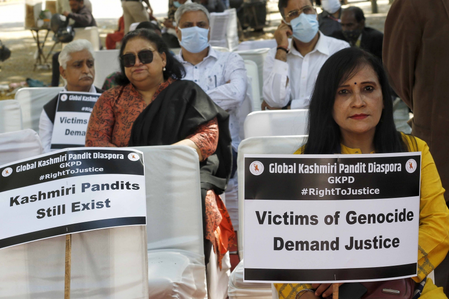
Kashmiri Hindu advocacy groups in the United States have reiterated their plea for justice, restoration, and secure rehabilitation of the community, observing January 19 as Exodus Day. The Kashmir Hindu Foundation and Panun Kashmir highlighted this date as a stark reminder of the forced displacement of Kashmiri Hindus from the Valley. They emphasized that January 19 signifies a deliberate campaign of ethnic cleansing that uprooted an indigenous community, causing them to lose not just their homes but also their roots and cultural identity.
Sunanda Vashisht, a writer and political commentator, along with being the Chairperson of the Jonaraja Institute of Genocide and Atrocities Studies, emphasized that the atrocities against Kashmiri Hindus should not be viewed as a singular historical event. She stated that genocide is a continuous process aimed at eradicating or significantly weakening specific identity-based groups perceived as threats to the offenders’ dominance or identity.
Dr. Agnishekhar, the Convener of Panun Kashmir, asserted that the return and rehabilitation of displaced Kashmiri Hindus hinge on the implementation of the Margdarshan Resolution by the Indian Government. He criticized alternative approaches for failing to address the political, security, and civilizational dimensions of the issue.
Nitin Dhar, representing the Panun Kashmir Youth Wing, dismissed the notion of “Kashmiriyat” and highlighted the historical adherence to “Kashmir Deshachar,” a unique civilizational and cultural ethos that was later dismantled. He stressed that distorted narratives cannot supersede historical truths.
Deepak Ganju, the founder of Kashmir Hindu Foundation, demanded that all properties, movable and immovable, sold by displaced Kashmiri Pandits post-1989 be officially recognized as “distress sales.” He advocated for such transactions to be declared invalid, with possession reverting to the rightful owners as per land records.
Anit Monga, President of KHF, called for a comprehensive prohibition on the acquisition or encroachment of abandoned properties. The groups underscored that justice, restitution, and secure rehabilitation are not just legal but also moral imperatives. They urged India, civil society, and the global community to acknowledge the genocide and take resolute actions to ensure the dignified return of Kashmiri Hindus.
