


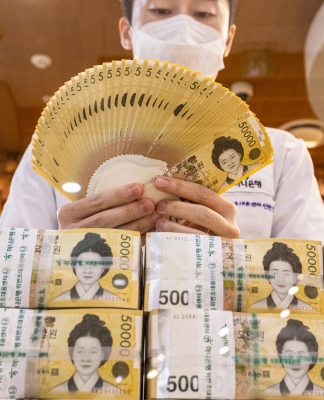
The Korean won’s real effective exchange rate dropped to its lowest level in over 17 years in June, standing at 82.99, a decrease of 1.75 points from the previous month, as per data from the Bank for International Settlements (BIS). This June figure marks the lowest since March 2009, following the global financial crisis, when the REER was at 79.31. The BIS’ REER assesses a currency’s value against major trading partners after adjusting for inflation, indicating international price competitiveness.
The decline in the REER was influenced by the won’s significant weakening against the U.S. dollar, reaching 1,555 won per dollar in intraday trading on June 30, the weakest level in more than 17 years. This depreciation was driven by substantial foreign selling of South Korean stocks and heightened dollar demand from local investors. Throughout June, the won averaged 1,527.95 against the U.S. dollar, the lowest monthly average since the Asian financial crisis in February 1998.
Seoul stocks recently experienced a nearly 6 percent decline, ending a three-day winning streak, amid escalating tensions in the Middle East that dampened risk appetite. The benchmark Korea Composite Stock Price Index (KOSPI) dropped 406.27 points, or 5.72 percent, to 6,690.62, reaching as low as 6,650.41. This sharp fall led the country’s bourse operator to halt program trading for five minutes during early trading. Trade volume was at 395.1 million shares valued at 30.9 trillion won (US$21.1 billion), with losers surpassing winners 582 to 301. Foreigners and institutional investors were net sellers, collectively offloading 5.2 trillion won, while retail investors acquired 5.18 trillion won.
