


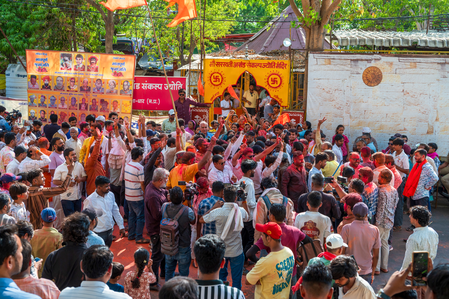
The All India Muslim Personal Law Board (AIMPLB) has declared its backing for a panel set to contest the Madhya Pradesh High Court ruling regarding the Bhojshala Kamal Maula Mosque dispute. The High Court judgment that reclassified the mosque complex as a Saraswati temple has been met with opposition from the AIMPLB. The Board’s spokesperson, S.Q.R. Ilyas, affirmed that the Kamal Maula Mosque Committee will challenge this decision in the Supreme Court with the Board’s full support.
Rejecting the High Court’s verdict, the AIMPLB emphasized that the judgment contradicts historical facts, official records, archaeological evidence, and even the previous stance of the Archaeological Survey of India (ASI). According to Ilyas, the High Court ruling prioritizes an assumed ancient temple and a cultural narrative, disregarding the mosque’s longstanding status, official documentation, ASI’s joint management agreement, and the post-Independence constitutional principle of safeguarding the religious identity of places of worship.
Ilyas pointed out that the ASI had previously acknowledged the site’s shared religious nature. He highlighted that ASI’s official records and signboards had long identified the location as “Bhojshala Kamal Maula Mosque,” recognizing its contested and shared religious status. The administrative arrangement of 2003 allowed Hindus to conduct puja on Tuesdays and Muslims to offer Friday prayers, indicating ASI’s acknowledgment of both communities’ historical claims and worship rights.
ASI’s recent survey reportedly cited pillars, carvings, and architectural elements as evidence of a temple, but Ilyas argued that the presence of non-Islamic architectural remnants does not legally negate the mosque’s centuries-old status. He stressed that remnants of a prior structure cannot definitively establish the current religious identity of a site. The High Court’s heavy reliance on Raja Bhoj traditions, Sanskrit learning history, and ASI findings, while overlooking continuous religious use, official records, and constitutional principles, has been criticized by Ilyas.
Ilyas cautioned against placing excessive faith in literary and traditional references as conclusive historical proof, noting the transformation of numerous religious sites over different historical eras.
