


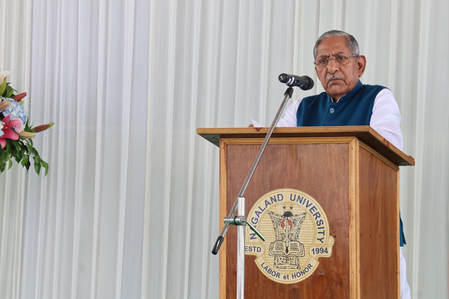
Nagaland Governor Nand Kishore Yadav emphasized the need for academic institutions, researchers, policymakers, and civil society organizations to collectively document, preserve, and reinterpret the tribal heritage of Northeast India. Speaking at the National Seminar on “Revisiting Tribal Heritage of Northeast India” at Nagaland University, he highlighted the importance of ensuring cultural sensitivity and inclusivity in development efforts. Governor Yadav stressed the role of universities in safeguarding indigenous traditions and knowledge systems, promoting local languages, and integrating traditional wisdom with modern scholarship.
The Governor acknowledged the diverse tribes, languages, customs, and indigenous knowledge systems in Northeast India, underscoring their significance as part of India’s cultural legacy. He expressed concerns about the impact of globalization, modernization, and technological advancements on traditional institutions and practices. Governor Yadav noted the decline of indigenous languages, oral traditions, and cultural roots among younger generations, emphasizing the need for academic discussions and research initiatives to preserve and revitalize tribal heritage in the region.
Yadav praised tribal communities for their traditional wisdom in areas like environmental conservation, sustainable living, and community harmony. He highlighted the relevance of indigenous knowledge systems in addressing contemporary global challenges such as ecological sustainability and social cohesion. The Governor commended the participation of scholars and experts from across the country in fostering deeper understanding and policy discussions on tribal heritage, identity, and development in Northeast India.
The National Seminar on the tribal heritage of Northeast India was organized by the School of Humanities and Education at Nagaland University’s Meriema Campus in Kohima. The event saw contributions from Prof. N. Venuh, Pro-Vice Chancellor of Nagaland University’s Kohima Campus, and Vice Chancellor Prof. Jagadish Kumar Patnaik, among others. With over 86.5% of Nagaland’s population belonging to various tribal communities, the preservation and promotion of indigenous heritage hold significant social and cultural importance in the state.
