


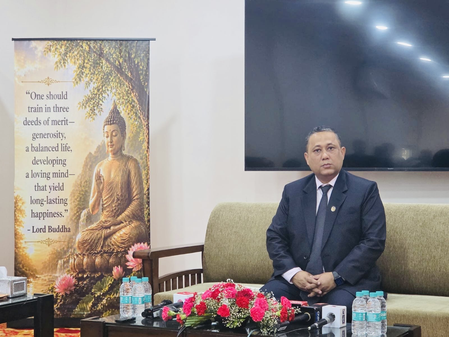
Nepal’s Foreign Minister Shishir Khanal is scheduled to embark on an official visit to China from June 14 to 17, just a week following his return from India. The visit, announced by both countries, will see Khanal engaging in bilateral discussions with Chinese Foreign Minister Wang Yi in Beijing. The agenda includes enhancing Nepal-China relations and fostering deeper cooperation, with Khanal also slated to attend an investment conference to boost foreign investment in Nepal.
China has been a significant investor in Nepal in recent years, with Chinese investors contributing a substantial portion of foreign direct investment (FDI) in the country. Despite this, India remains the leader in terms of accumulated FDI stock due to the substantial investments made in Nepal. Khanal’s visit to Beijing comes amidst efforts by Nepal’s new government, under Prime Minister Balendra Shah, to maintain a balanced relationship with both India and China, in line with Nepal’s foreign policy principles.
The Nepali government’s annual budget for fiscal year 2026-27 emphasizes the importance of balanced foreign relations for mutual benefit, national dignity, and economic prosperity through the mobilization of soft power. This visit is viewed as an opportunity for the new government to comprehend China’s stance towards Nepal in the evolving political landscape, while China seeks to understand the foreign policy approach of Nepal’s new ruling party, Rastriya Swatantra Party.
Former Nepali Ambassador to China, Bishnu Pukar Shrestha, highlighted the significance of Khanal’s visit for China to gauge the new government’s position on crucial issues. He emphasized China’s core interests in Tibet and Taiwan, stressing the importance of upholding the One-China policy. Additionally, China is keen on expediting projects under the Belt and Road Initiative (BRI) in Nepal, particularly in areas of connectivity, communication, and climate support.
Nepal’s commitment to maintaining “equal distance and equal proximity” with all nations, as outlined in its draft National Commitment Paper, reflects its stance on global peace. The country’s relationship with India is multifaceted, rooted in shared geography, culture, and religion, with close people-to-people ties and deep economic interdependence.
