


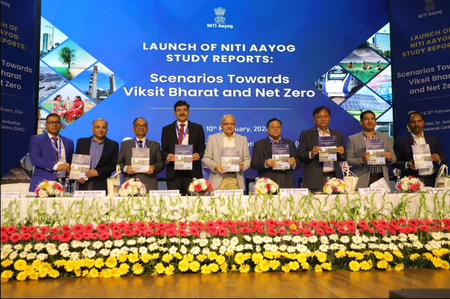
The NITI Aayog unveiled four Study Reports focusing on India’s path towards sustainable development and achieving Net Zero emissions. These reports delve into the transport, industry, power, and critical minerals sectors. By 2070, the power sector could witness a significant shift, with electricity potentially constituting 60% of the sector, up from 21% in 2025. Moreover, non-fossil fuel generation might surge to 80-85%.
In the industry domain, the demand for steel, cement, and aluminium is anticipated to surge 4-6 times by 2070. The reports highlight electricity and green hydrogen as pivotal elements in the industrial energy landscape. Furthermore, the recycling of critical minerals like copper and graphite could meet 20-25% of the demand by the mid-century.
The reports emphasize the importance of transitioning towards zero-emission vehicles, clean fuels, and technologies in the transport sector. They underscore the necessity of modal shifts, public and shared mobility solutions, and the adoption of zero-emission vehicles to align with sustainable mobility goals. The industrial sector’s evolution is marked by increasing electrification, material efficiency, and the integration of non-fossil energy sources.
The NITI Aayog’s reports also shed light on the power sector’s pivotal role in India’s journey towards sustainable development and Net Zero emissions. The assessments project a surge in electricity demand due to factors like urbanization, digitalization, and electric mobility. The reports advocate for rapid electrification, extensive renewable energy deployment, and enhanced storage and transmission infrastructure for a reliable and clean power system.
NITI Aayog officials stressed the urgency of transitioning to clean energy and new fuels like green hydrogen to achieve India’s sustainable development goals. They highlighted the need for swift implementation of necessary technologies and cost reduction measures to propel the country towards a cleaner and more efficient energy landscape.
