


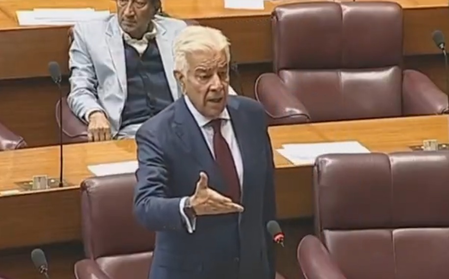
Pakistan’s Defence Minister Khawaja Asif explained that Pakistan’s engagement in Afghanistan’s conflicts over the years was driven by political considerations and the pursuit of support from global powers rather than religious reasons. Asif emphasized that Pakistan’s participation in wars related to Afghanistan, spanning from the Cold War era to post-9/11 events, was a strategic decision aimed at garnering international backing, particularly from the United States.
He highlighted that Pakistan’s historical approach towards Afghanistan has been shaped by changing geopolitical dynamics. Asif pointed out that the involvement labeled as “jihad” during the Soviet-Afghan conflict was essentially a proxy battle involving major global players, rather than a religious crusade. He underscored that this conflict was not a religious war but a strategic maneuver involving superpowers.
Asif acknowledged that Pakistan’s educational system and societal fabric were influenced by the conflict narrative, leading to long-lasting social and ideological repercussions. He admitted that Pakistan continued its alignment with the US post-9/11, participating in the American-led military campaign in Afghanistan for nearly two decades. Asif remarked that Pakistan’s primary objective during this period was to secure American support, reflecting on the country’s foreign policy decisions.
