


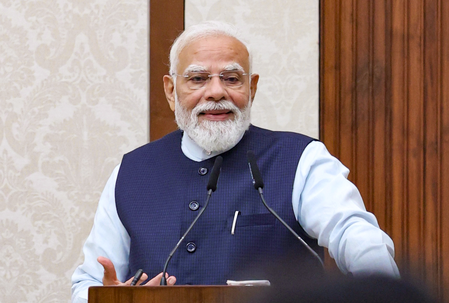
On the 51st Anniversary of the Emergency imposed by Indira Gandhi’s government in 1975, Prime Minister Narendra Modi labeled its imposition as a “grave sin” and the “darkest chapter in the history of Indian democracy.” He urged citizens to “never forgive nor forget” those responsible. PM Modi highlighted how the Emergency period oppressed citizens’ rights and media freedoms, with opposition leaders arrested and political dissent severely suppressed.
During the Emergency, all forms of political dissent were crushed, leading to the arrest and torture of thinkers, writers, journalists, social workers, students, and ordinary citizens. The Constitution was disregarded, and attempts to politicize the judiciary were made. Media outlets faced restrictions, with non-compliant ones shut down or silenced through intimidation. Fundamental rights were suspended, and Parliament was reduced to a mere “rubber stamp.”
PM Modi emphasized that every institution meant to safeguard citizens was turned against them during the Emergency. He acknowledged the individuals who bravely resisted the draconian laws at personal cost, uniting across backgrounds and ideologies to protect democracy and constitutional values. The mass movement against the Emergency compelled the Congress government to yield to the public’s power, leading to the eventual lifting of the Emergency and electoral defeat for its proponents.
Critiquing the Congress, PM Modi stated that those who imposed the Emergency bear the enduring stigma of this “grave sin.” He praised the individuals who stood resolute, asserting that democracy endured due to their efforts. Addressing the nation, he urged, “Never Forgive. Never Forget.”
