


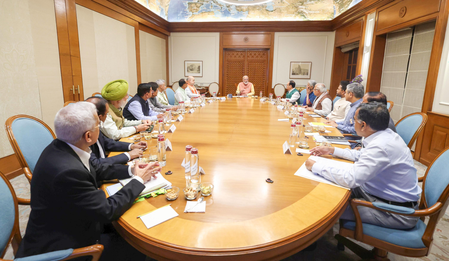
Prime Minister Narendra Modi led a meeting of the Cabinet Committee on Security (CCS) to assess the evolving situation in West Asia and its potential impact on India’s national interests. This meeting, the second since tensions escalated on February 28, 2026, due to US-Israel airstrikes on Iranian targets, discussed disruptions in the region, including in the Strait of Hormuz, and global energy market volatility. Attended by key ministers like Rajnath Singh, Amit Shah, S. Jaishankar, Nirmala Sitharaman, Hardeep Singh Puri, and Piyush Goyal, the high-level meeting also saw the presence of other ministers like Shivraj Singh Chouhan, J.P. Nadda, and Ashwini Vaishnaw.
National Security Adviser Ajit Doval and senior officials, including Principal Secretaries and Cabinet Secretary T.V. Somanathan, were also part of the meeting. The discussion revolved around the crisis’s short-, medium-, and long-term implications on sectors such as energy security, petroleum imports, agriculture, exports, and finance. With a significant portion of global oil trade passing through the Strait of Hormuz, India, a major importer of West Asian energy supplies, is evaluating potential risks to fuel prices and industrial inputs.
The meeting also addressed the current macroeconomic situation, focusing on immediate safeguards and long-term strategies to enhance resilience. Recent efforts by the government include diversifying energy sources, maintaining essential commodity stocks, and ensuring uninterrupted domestic supply. India’s stance emphasizes de-escalation, dialogue, and safeguarding civilian lives and critical infrastructure, aiming to mitigate external shocks while maintaining a balanced diplomatic approach in a volatile geopolitical landscape.
