


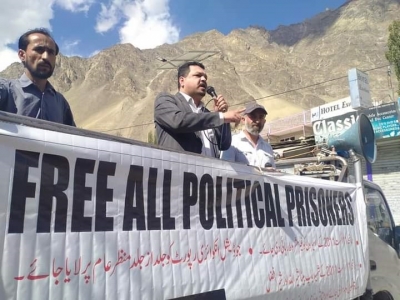
The ongoing political crisis in Pakistan-occupied Kashmir (PoK) reveals a significant gap between the local population and a compliant regional administration that answers to Islamabad. Recent actions, such as banning the Joint Awami Action Committee (JAAC) and using force in the region, indicate a military-led approach to quash genuine local dissent and calls for political change. The unrest, resulting in numerous casualties, escalated following the outlawing of JAAC as a “terrorist” group on June 5.
The report emphasizes that Islamabad has historically controlled the region through mainstream Pakistani parties, limiting space for local political entities. Elections in PoK and Pakistan-occupied Gilgit-Baltistan (PoGB) have consistently favored the ruling party in Islamabad, suggesting a lack of genuine democratic processes. Despite the narrative that continuity in ruling parties leads to better governance, both PoK and PoGB remain underdeveloped and marginalized.
The report underscores Islamabad’s interference in local politics, indicating a reluctance to alter the existing power structure in PoK. With upcoming elections on July 27, it predicts a continuation of the status quo, with Islamabad retaining control over the local government. The military’s strong stance to maintain the current order, even through violent means, highlights a pattern of suppressing dissent against Islamabad in PoK.
JAAC’s leader, Shaukat Nawaz Mir, has condemned the violent crackdown in Rawalakot, labeling it as a massacre. The report warns that the forthcoming General Elections in PoK are likely to perpetuate violence, reinforcing a puppet regime aligned with the military’s interests while disregarding the genuine grievances of the Kashmiri populace.
