


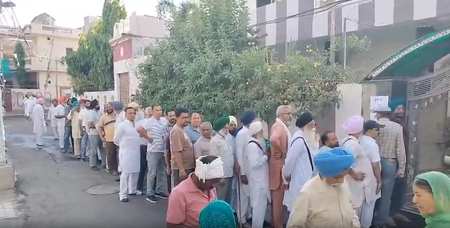
Ahead of the scheduled 2027 Assembly elections in Punjab, the state conducted municipal elections to choose councillors for 1,896 wards and eight municipal corporations under tight security. A significant number of 35.45 lakh voters are expected to cast their votes by 5 p.m., with voters arriving early at polling stations. The state Election Commission deployed around 32,000 police personnel and 35,000 election staff to ensure fair elections across various local bodies.
The eight municipal corporations where elections are being held are located in Abohar, Mohali, Moga, Bathinda, Barnala, Batala, Kapurthala, and Pathankot. A total of 7,555 candidates are contesting, with major parties like the Aam Aadmi Party, Congress, BJP, Shiromani Akali Dal, and Bahujan Samaj Party fielding candidates. The electorate consists of 18,33,712 male voters, 17,11,635 female voters, and 220 voters in the “other” category.
Prior to the municipal elections, the Punjab and Haryana High Court dismissed a PIL challenging the Election Commission’s decision to switch from electronic voting machines (EVMs) to ballot papers. The shift to ballot papers was contested for lacking statutory amendment, legislative approval, or public consultation. Despite the plea’s dismissal, the Supreme Court also rejected a petition seeking the use of EVMs in place of ballot papers for the ongoing municipal elections.
State BJP President Sunil Jakhar cautioned against any illegal tactics in winning the local body elections, criticizing AAP for alleged fear-mongering. The BJP, which has seen significant growth in Punjab politics, expressed confidence in its expanding influence across urban and rural areas. The party’s improved standing was highlighted by increased candidate interest and absence of protests during the current elections, contrasting with the challenges faced in the 2021 local body polls.
