


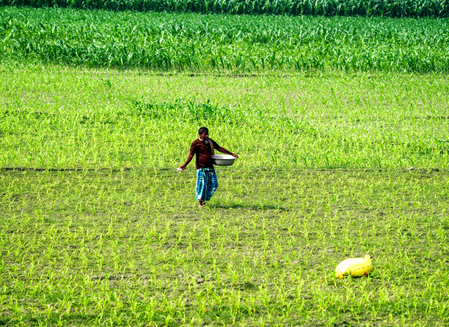
The Ministry of Agriculture and Farmers Welfare revealed that the total area sown under rabi crops this winter has expanded by 17.65 lakh hectares to reach 644.29 lakh hectares as of January 9, up from 626.64 lakh hectares last year. This increase in sown area is anticipated to enhance production, potentially raising farmers’ incomes and aiding in controlling food inflation.
Notably, the pulse area has increased by 3.74 lakh hectares, with gram sowing showing a substantial rise of 4.66 lakh hectares. Wheat cultivation has also seen a rise to 334.17 lakh hectares from 328.04 lakh hectares in the corresponding period last year.
Furthermore, the area under pulses like urad, lentils (masur), gram, and moong has expanded by 3.74 lakh hectares to 136.36 lakh hectares from 132.61 lakh hectares in the same period last year. The cultivation area for coarse cereals or millets such as jowar, bajra, and ragi has grown to 55.20 lakh hectares this season, compared to 53.17 lakh hectares in the previous year.
Additionally, the area allocated for oilseeds like rapeseed and mustard has risen to 96.86 lakh hectares from 93.33 lakh hectares in the corresponding period last year. The Cabinet Committee on Economic Affairs (CCEA) approved an increase in the minimum support prices (MSP) for all mandated rabi crops for the 2026-27 marketing season on October 1, 2025, to ensure profitable prices for farmers.
The surge in sown area this season can be attributed to favorable monsoon rains that have facilitated sowing in unirrigated regions, which constitute nearly half of the country’s farmland.
