


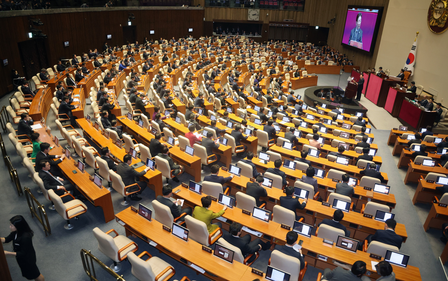
The South Korea’s National Assembly is preparing to review an additional budget proposal on Friday to address the economic impact of the ongoing conflict in the Middle East. Initially set at 26.2 trillion won, the supplementary budget has now expanded to approximately 30 trillion won after assessments by standing committees. This budget aims to mitigate the effects of soaring oil prices and provide support to small businesses and vulnerable households affected by the crisis.
Rival political parties had agreed to pass the bill by Friday, but disagreements persist regarding specific budget details. One contentious issue involves the government’s proposal to offer financial aid to the bottom 70 percent of income earners, with varying amounts ranging from 100,000 won to 600,000 won per person based on income level and region. The opposition People Power Party has criticized the bill, suggesting that the included projects do not align with the budget’s intended purpose, advocating for more direct assistance programs for affected individuals.
If approved, approximately 35.8 million people are expected to benefit from the financial aid scheme. The ruling Democratic Party is pushing for the swift approval of the bill to expedite the relief measures. A plenary session is scheduled at the National Assembly later in the day to deliberate on the proposed budget and its components.
In a separate development on April 7, South Korea announced securing an additional 60 million barrels of alternative oil supplies for May to substitute the disrupted Middle Eastern oil shipments due to the closure of the Strait of Hormuz. The country has so far secured a total of 110 million barrels of oil from 17 countries, including Saudi Arabia, the United States, the United Arab Emirates, Brazil, and Canada. This strategic move aims to ensure a stable oil supply, with the recent agreements covering about 60 percent and 70 percent of the usual monthly oil imports for April and May, respectively.
Furthermore, South Korea’s major refineries have engaged in the oil swap system, with plans to borrow over 30 million barrels under this initiative. Approximately 8 million barrels are expected to be delivered this week as part of the ongoing efforts to manage the oil supply challenges effectively.
