


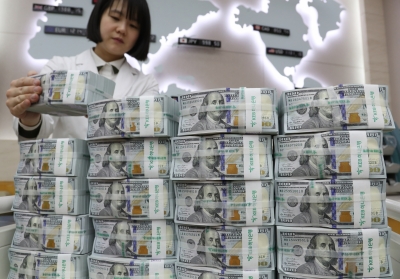
South Korea’s per capita income in 2025 saw a slight 0.3% rise, reaching $36,855, despite solid income growth being offset by the weakening Korean won against the US dollar, according to data from the Bank of Korea. The nominal per capita gross national income (GNI) increased by 0.3% from the previous year. The GNI in terms of the Korean won rose by 4.6% to 52.42 million won in 2025, as reported by Yonhap news agency.
The per capita income in South Korea first exceeded $30,000 in 2014 and almost reached $38,000 in 2021. However, it dropped to the $35,000 range in 2022 before bouncing back to $36,195 in 2023. Subsequently, growth slowed to 1.5% in 2024 and further to 0.3% in the following year, maintaining the figure in the $36,000 range for the third consecutive year.
Nominal gross domestic product (GDP) in South Korea grew by 4.2% year-on-year to 2,663.3 trillion won in 2025. However, due to the weaker won, it decreased by 0.1% in dollar terms to $1.87 trillion. The Korean won depreciated by 4.3% against the dollar in 2025 due to imbalances in foreign exchange supply and demand, along with significant overseas securities investments by local investors, among other factors, as stated by the central bank.
Kim Hwa-yong, head of the BOK’s national income department, mentioned that Taiwan’s per capita GNI in 2025 reached $40,585, benefiting from the semiconductor boom. Japan also experienced an increase in per capita GNI to around $38,000 following a base-year revision in December the previous year. Among countries with populations exceeding 50 million, South Korea ranked sixth in per capita GNI, trailing the United States, Germany, Britain, France, and Italy.
The official from the Bank of Korea expressed optimism, stating that if there are no further effects from the won-dollar exchange rate, South Korea’s per capita GNI is projected to surpass $40,000 in 2027.
